With the enactment of the new EU Battery Regulations (entered in to force on 17th August 2023), organisations are required to embrace Battery Passports and Smart Labelling, enabling transparency and sustainability in battery production and consumption. However, my research highlights critical gaps in awareness, information availability, and operational readiness raced by organisations in aligning with these legislative changes.
A representative survey was conducted to gauge the awareness and preparedness of 80 organisations in regard to the new EU Battery Regulations. An Industry-Academic round table discussion and follow-up interviews were then held to reflect on the implications for Industry. The results can be downloaded in these two reports.
Timms, P. D. & King, M. R. N. (2023) ‘EU Battery Regulations 2023: UK Readiness for Battery Passports and Smart Labelling – Report on a round table discussion and follow-up interviews’, DOI:https://doi.org/10.17028/rd.lboro.24083982
King, M. R. N., & Timms, P. D., (2023) ‘EU Battery Regulations 2023: UK Readiness for Battery Passports and Smart Labelling –A survey of UK-based organisations and those that supply to the UK/EU’, DOI: https://doi.org/10.17028/rd.lboro.24083991
This Survey closed on the 3rd March2023. Organisations were asked to take part if they: Produce, manufacture, assemble, import, distribute, sell, operate, maintain, repair, refurbish, upgrade, remanufacture, recover, reuse, and recycle any type of battery, or any products that incorporate batteries.
You don’t need to have an awareness of the EU’s new regulations to fill in this survey, we want to capture UK’s current levels of awareness and preparedness.
Please can you spare between 15 – 60 minutes (you may not need to fill out all sections) to take part in this survey? In the process you will find out more about the EU’s current trajectory for Battery Passports in the context of the forthcoming EU Battery Regulations. The synthesised and anonymised results will be publicly available and will be used to feed into UK Policy discussions.
If you would like to read the questions we will ask before completing the survey, a copy can be downloaded here.
If you would like to read our explanations of the new information requirements and their impact on your organisation, a copy can be downloaded here.
This work is being carried out as part of my funded project. The award comes via the Interact Network, which aims to bring together economic and social scientists, UK manufacturers, and digital technology providers to address the human issues resulting from the diffusion of new technologies in industry. Made Smarter Network+. ESRC Grant no: ES/W007231/1.
NOTE – this blog post relates to a 2023 reserach project which was analysing the evolving EU Batteries Regulation.
The EU is soon to adopt new regulations for batteries and battery waste. For electric vehicle, and industrial batteries, producers will need to adopt and develop systems that can supply information into an EU centrally-managed data space, termed the European Electronic Exchange System(EEES) for battery information.
This article explains the likely requirements, based on currently-available information. Please note, that while general shape of the regulation and it’s requirements is reasonably well known, until the regulation is officially published and comes into force, these information requirements may change. See ‘regulatory background’ below for more detail.
The EEES, and its role in the battery information ecosystem
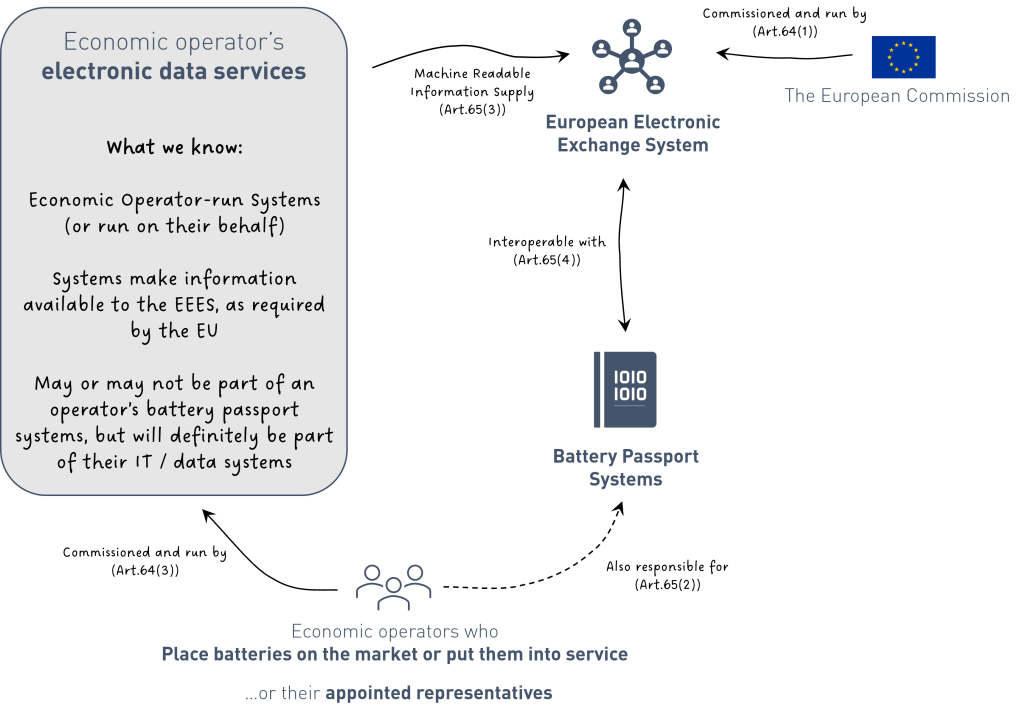
The European Electronic Exchange System (EEES) for battery information is one of three new information systems, proposed under COM/2020/798, to improve the transfer of information between different stakeholders in the battery value chain. In addition to the EEES, the regulation also introduces battery passports and QR smart labels, with the regulations mandating interoperability and integration between these systems and the EEES.
While these are generally presented as three separate systems in separate sections of the regulation, in practice they characterize different subsets of functionality of a larger battery information ecosystem, that transfers (and makes available) information across a manufacturer’s ecosystem. In effect, each system becomes a portal into a common information environment. Importantly though, battery passport and EEES functionalities are only required for electric vehicle, industrial, and light means of transport batteries,, whereas the QR smart label functionalities will be required for all battery types.
About the European Electronic Exchange System
According to the EU (Article 64(2)), the EEES is being set up to facilitate easier sorting and searching of information and data, and is intended to (Article 64(1a)):
(a) support market surveillance authorities carry out their tasks and responsibilities
(b) provide public with battery information sheets, and information on the sustainability and safety of batteries placed on the market.
(c) provide the commission and accredited remanufacturers, second-life operators and recyclers with up-to-date information about those batteries.
The EEES will act as a “regularly updated database for all batteries falling under this regulation” (Article 64(2)). As per Article 64(4), the EEES will also be used by member states to report production, waste collection and recycling efficiency information to the commission. In the context of battery passports, the role of the EEES is focused on the sharing of information at the level of a given battery model or type. However, the wider system likely to have some asset-specific traceability and reporting, given its integrated nature with manufacturer’s battery passport systems (Article 65(3)), and the need to report organisation-level performance of waste management for compliance purposes, in addition to the product-level information discussed below.
As per Article 64(3), economic operators (that place applicable batteries in the market) must put in place systems that can supply the necessary information (detailed below) “electronically in a machine readable format using interoperable and easily accessible data services”. The architecture/design of the EEES is not yet defined, nor has the EU specified the format that information should be shared in, but they will do so by 31 December 2024 (Article 64(5)), along with “rules for accessing, sharing, managing, exploring, publishing and reusing of the information and data in the system”. As per Article 64(2), the EEES will be based on “open standards for third party use”. The end goal is a system providing access to information about all (relevant) batteries, from all economic operators, that is easily “sortable and searchable” (Article 64(3).
The EEES will, based on the current regulatory scope, collect information pertaining to industrial, electric vehicle, and light means of transport batteries. Economic operators (who place relevant batteries onto the market or into service) will be responsible for supplying this information, in the format that the EU has yet to specify. This information will be required from 1 January 2026.
What product-related information goes into the EEES?
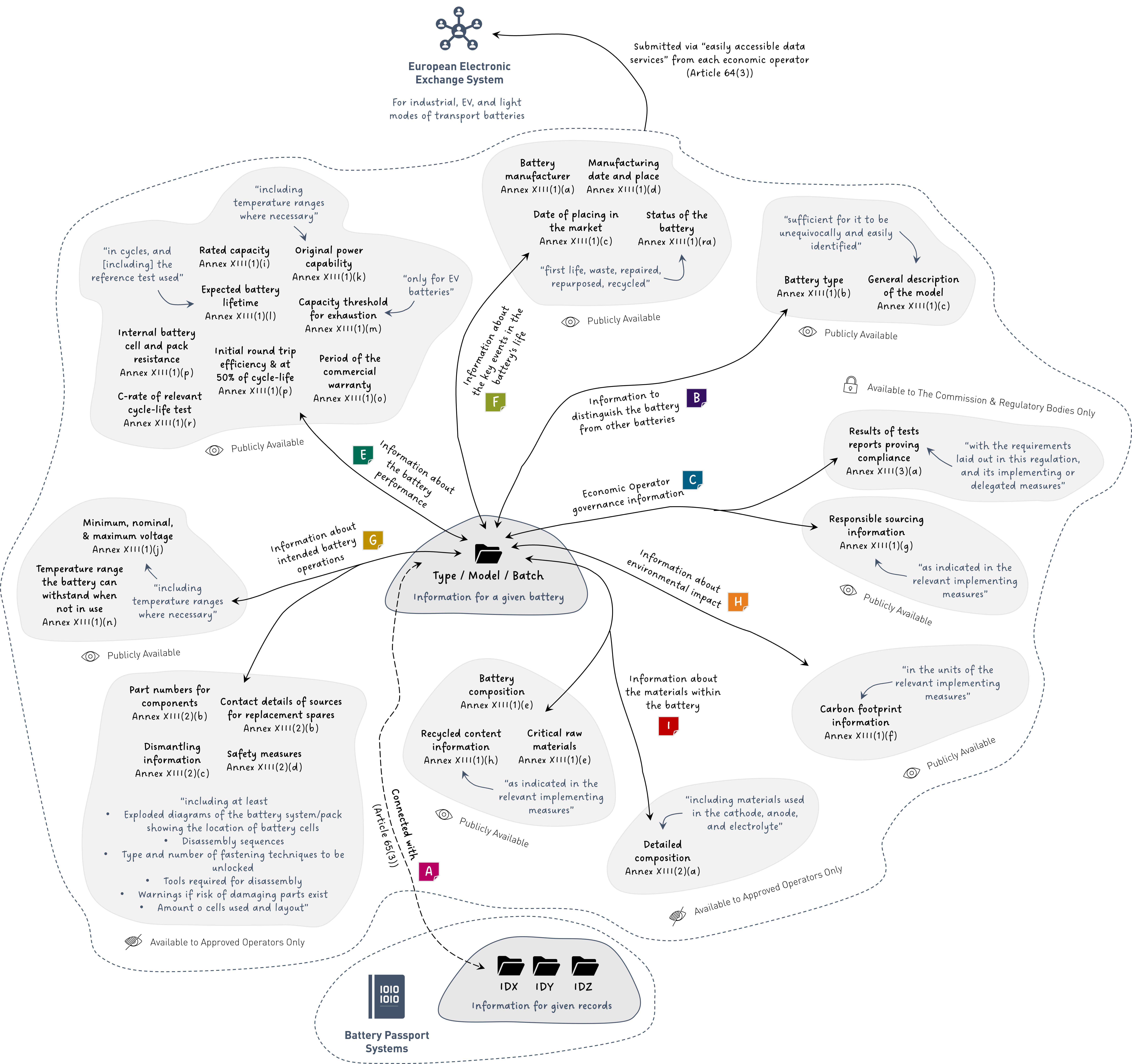
Article 64(2) (cross referencing Annex XIII) sets out the information that must be provided to the EEES by each economic operator. Annex XIII groups this information into three classes, based on who it is expected will be permitted to access the information from the EEES (albeit recognizing that, as per Article 64(5)(c), complete rules for “accessing, sharing, managing, exploring, publishing and reusing” the information contained within / accessible via the EEES will not be established until 31 December 2024). In all cases, this information must be available by 1 January 2026.
Information to be stored and made available in the publicly accessible part of the system by the economic operator that places a battery on the market
Annex XIII(1)(a) Battery manufacturer;
Annex XIII(1)(b) Battery type;
Annex XIII(1)(c) General description of the model, sufficient for it to be unequivocally and easily identified, including the date of placing in the market;
Annex XIII(1)(d) Manufacturing place and date;
Annex XIII(1)(e) Battery composition, including critical raw materials;
Annex XIII(1)(f) Carbon footprint information in the units indicated in the relevant implementing measure(s);
Annex XIII(1)(g) Information on responsible sourcing as indicated in the relevant implementing measure(s);
Annex XIII(1)(h) Recycled content information as indicated in the relevant implementing measure(s);
Annex XIII(1)(i) Rated capacity (in Ah);
Annex XIII(1)(j) Minimal, nominal and maximum voltage, with temperature ranges when relevant;
Annex XIII(1)(k) Original power capability (in Watts) and limits, with temperature range when relevant ;
Annex XIII(1)(l) Expected battery lifetime expressed in cycles, and reference test used;
Annex XIII(1)(m) Capacity threshold for exhaustion (only for EV batteries);
Annex XIII(1)(n) Temperature range the battery can withstand when not in use (reference test);
Annex XIII(1)(o) Period for which the commercial warranty for the calendar life applies;
Annex XIII(1)(p) Initial round trip energy efficiency and at 50% of cycle-life;
Annex XIII(1)(q) Internal battery cell and pack resistance;
Annex XIII(1)(r) C-rate of relevant cycle-life test.
Annex XIII(1)(ra) Status of the battery (first life, waste, repaired, repurposed, recycled).
The part of the system that shall be accessible only to accredited remanufacturers, second-life operators and recyclers shall contain:
Annex XIII(2)(a) Detailed composition, including materials used in the cathode, anode and electrolyte;
Annex XIII(2)(b) Part numbers for components and contact details of sources for replacement spares;
Annex XIII(2)(c) Dismantling information, including at least:
Exploded diagrams of the battery system/pack showing the location of battery cells,
Disassembly sequences,
Type and number of fastening techniques to be unlocked,
Tools required for disassembly,
Warnings if risk of damaging parts exist,
Amount of cells used and layout;
Annex XIII(2)(d) Safety measures
The part of the systemthat is accessible only to notified bodies, market surveillance authorities and the commission
Annex XIII(3)(a) Results of tests reports proving compliance with the requirements laid out in this Regulation, and its implementing or delegated measures.
Who is responsible for the product-related information in the European Electronic Exchange System?
As per Article 64(3), economic operators (that place applicable batteries in the market) must put in place systems that can supply the necessary information (detailed below) “electronically in a machine readable format using interoperable and easily accessible data services”.
We hope that this information is useful to build awareness of the future information requirements for the EEES. However, we present this information (January 2023) without guarantee to its accuracy, given the transient nature of the EU regulatory development process, and the complexity of the regulations. Those seeking to understand the regulations in more detail are encouraged to read the original commission text and parliamentary amendments in more detail.
Regulatory Background
This European Regulation exists within a process of three stages and three sets of actors:
The European Commission (the EU’s politically independent executive arm) is responsible for drawing up proposals for new European legislation, and implementing these once agreed upon by the European Parliament and the Council of the EU. The European Commission (EC) first published its Proposal for a REGULATION OF THE EUROPEAN PARLIAMENT AND OF THE COUNCIL concerning batteries and waste batteries, repealing Directive 2006/66/EC and amending Regulation (EU) No 2019/1020 (source), on 10 December 2020.
The European Parliament (the EU’s elected governing body) is the EU’s lawmaking arm, responsible for passing EU laws, together with the Council of the EU. On 10 March 2022 (source), the European Parliament agreed to the council proposal, with amendments (source), principally to raise the level of ambition in the legislation.
The Council of the EU contains representatives of each member state in the EU, responsible for committing their respective governments to any agreed actions in EU meetings, including the adoption of new laws. On 9 December 2022 (source) it was announced that inter-institutional negotiations, between the commission, parliament, and the council of the EU had resulted in provisional agreement, that must now be formally approved by the commission and parliament.
The above information is based upon the amendments made by the European Parliament, as the content of the third-stage negotiations has not yet been published. Progress of this regulation can be tracked via the EU’s legislative train and procedure file pages.
NOTE – this blog post relates to a 2023 reserach project which was analysing the evolving EU Batteries Regulation.
The EU is soon to adopt new regulations for batteries and battery waste. One significant part of these regulations is the introduction of a Smart QR Code, fitted to every battery product, that will give users access to a range of important information points information related to their battery’s capacity, performance, durability, chemical composition. Producers will need to adopt and develop QR Smart Label Systems, capable of supplying the information required by the EU.
This article explains the likely requirements, based on currently-available information. Please note, that while general shape of the regulation and it’s requirements is reasonably well known, until the regulation is officially published and comes into force, these information requirements may change. See ‘regulatory background’ below for more detail.
QR Smart Labels, and their role in the battery information ecosystem
QR Smart Labels are one of three new information systems, proposed under COM/2020/798, to improve the transfer of information between different stakeholders in the battery value chain. The other systems are a Battery Passport System, and an EU-operated Electronic Exchange System. While presented in separate articles of the regulation, these three information systems are inherently part of the same information ecosystem, with the regulations mandating interoperability and integration between the systems.
While these are generally presented as three separate systems in separate sections of the regulation, in practice they characterize different subsets of functionality of a larger battery information ecosystem, that transfers (and makes available) information across a manufacturer’s ecosystem. In effect, each system becomes a portal into a common information environment.
About Battery Labeling, and the requirements for QR Codes
The proposed regulation sets out new labeling requirements for battery products (cells, modules, and packs placed on the market) in Article 13. Specifically, Article 13(5) sets out new requirements for all finished battery products to include a QR code, that provides access to a range of information (below). These QR codes must be printed or engraved visibly, legibly and indelibly on the battery, and/or when batteries are incorporated in appliances, the QR code must be printed or engraved visibly, legible and indelibly on the appliances (Article 13(6)).
QR codes are “machine-readable matrix code[s] that link[] to information as required by this regulation” (Article 2(21)). They must be in accordance with Part C of Annex VI.
The QR code shall be in a colour with a high contrast compared to its background and of a size that is easily readable by a commonly available QR reader, such as those integrated in hand-held communication devices.
Part C of Annex VI
In accordance with Recital 28, QR codes should “respect the guidelines of ISO IEC Standard 18004“, and should also “be accessible for persons with disabilities in accordance with the requirements laid down in Directive (EU) 2019/882 of the European Parliament and of the Council”.
There is an exception within Article 13(6) that, “where it is not possible or not warranted on account of the nature and size of the battery, labels shall be affixed to the packaging and to the documents accompanying the battery”, however it must be noted that this exception does not explicitly call-out the QR code, whereas it does in other sentences of this requirement. Thus, in present form, it could be interpreted that the QR code must be on the battery in all circumstances.
It should be noted that, while the regulation focuses on the QR code technology, Article 13(6a) does give the commission the ability to adopt “alternative types of smart labels instead of or in addition to the QR-code, in view of technical and scientific progress”.
About QR Smart Label Systems
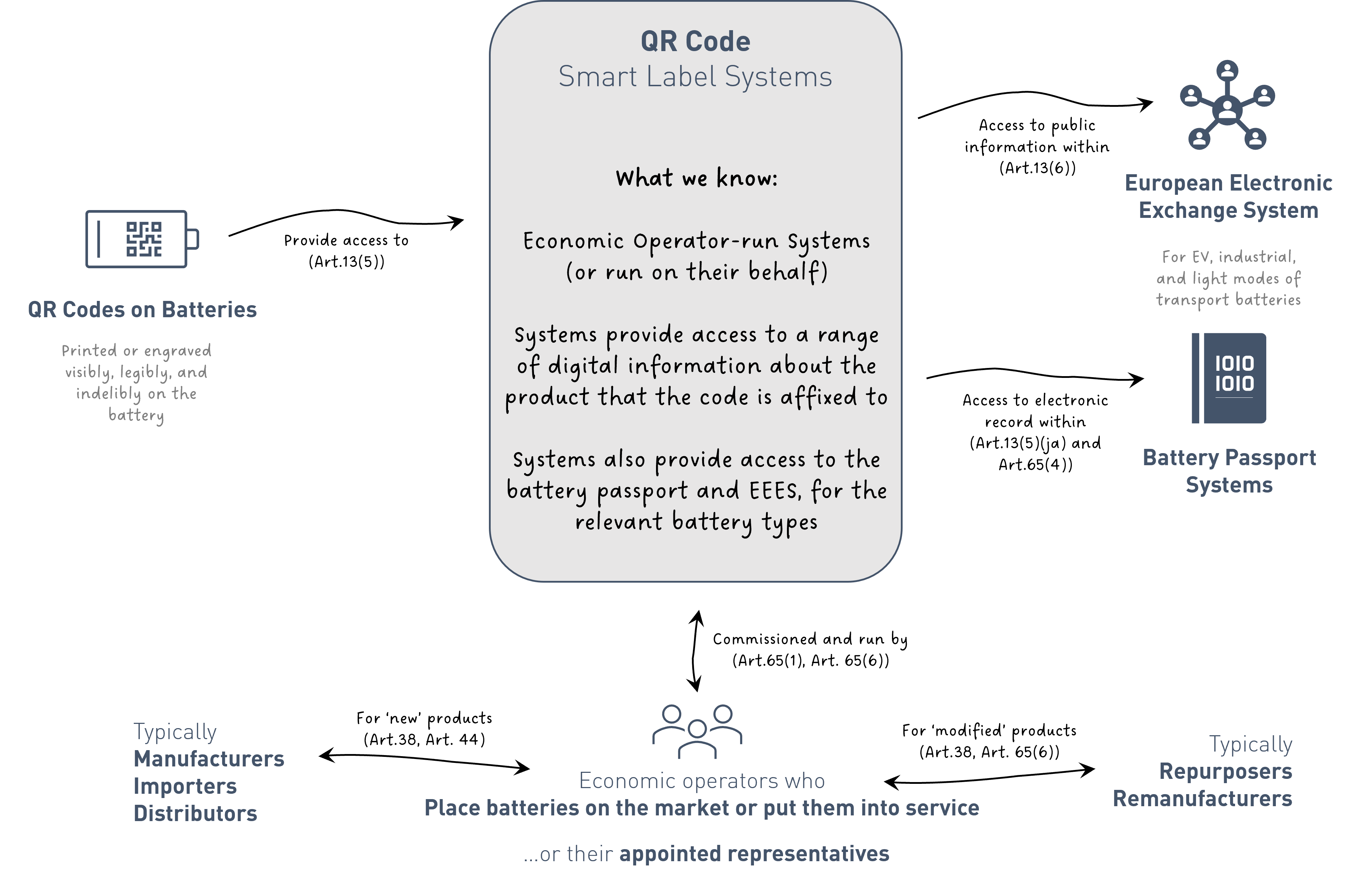
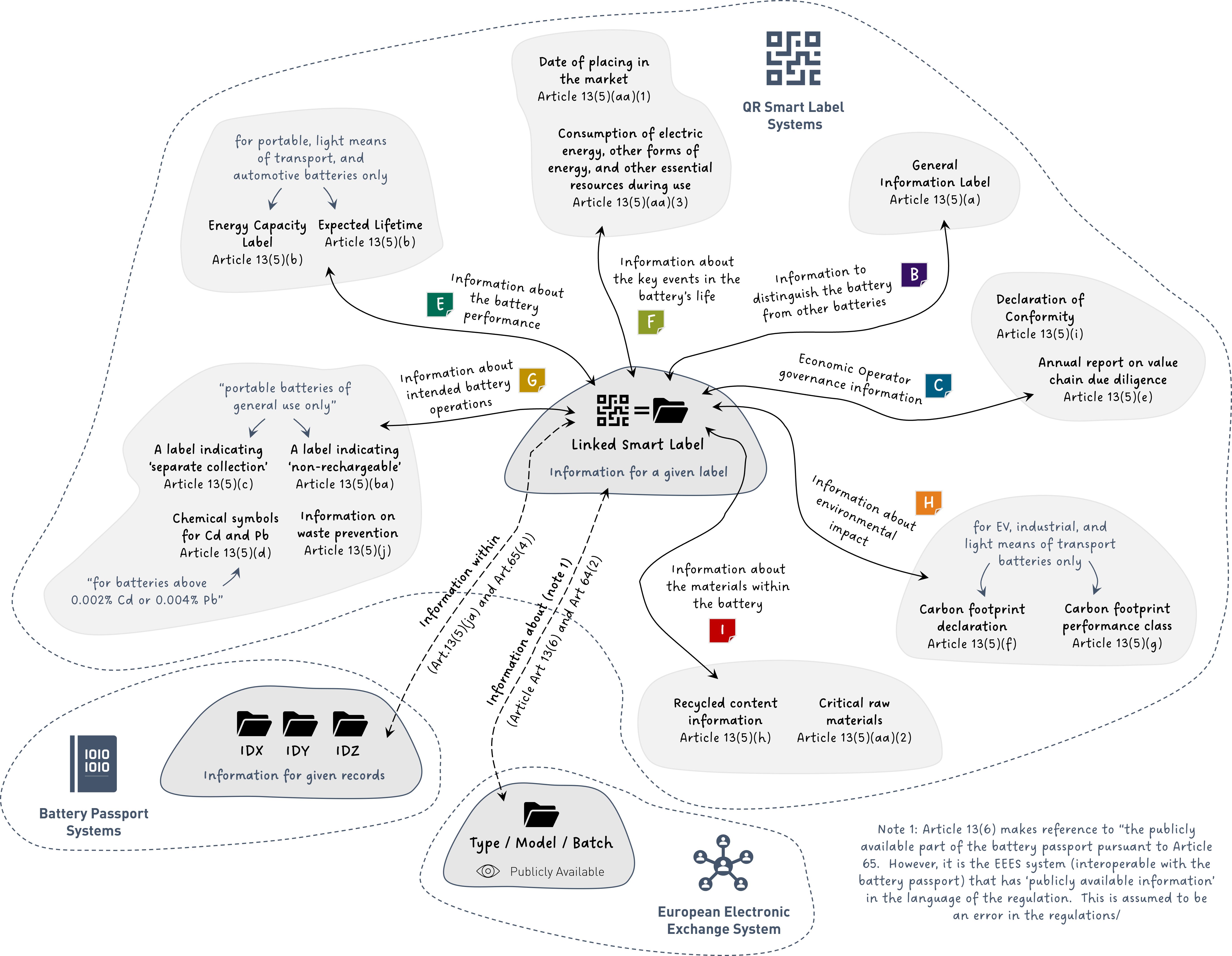
QR Smart Label systems are required, that can provide access via the QR code (fitted to battery products), to information specified in (and cross-referenced from) Article 13(5)(5) and Article 13(5)(6). This information is detailed below. In accordance with Article 13(5)(ja) and Article 65(4), from 1 January 2026 (for industrial, electric vehicle, and light means of transport batteries), the QR code must also link (provide online access) to the information contained within the battery passport.
In Article 13(6), it is currently stated that “the QR code shall also provide access to the publicly accessible part of the battery passport established pursuant to Article 65”. It is worth noting that Article 65 does not make reference to publicly accessible information. Battery passports are however meant to interoperate, and link to, the proposed Electronic Exchange System (EES) (as per Article 65(4)). The information requirements of the EES are set out in Annex XIII (as per Article 64(2)), where the notion of publicly accessible information is set out. It is reasonable to assume that this is the intent of this sentence within Article 13(6) – for the QR code to provide access to the EES system, rather than repeat the requirement for battery passport information, that is also set out in Article 13(5)(ja).
Notably, in accordance with Article 65(2), the battery passport “shall be unique for each individual battery”, and so the QR code may need to be individual-asset-specific, dependent on implementation.
What information goes into the QR smart label?
QR codes must provide access to the information set out in Article 13(5) and Article 13(6). Based on the deadlines currently set out in the parliamentary amendments to the regulation, the following information must be made available.
It must be noted that some of these deadlines have already passed, even though the regulation has yet to come into force, thus it is likely that some of these compliance dates may change.
1 January 2023
Art.13(5)(ba) → Art.13(2a) A label indicating ‘non-rechargeable’ (for portable batteries of general use only)
Art.13(5)(c) → Art.13(3)→ Annex VI(Part B) A label indicating separate collection (for portable batteries of general use only)
Art.13(5)(d)→ Art.13(4) The chemical symbols for cadmium and lead (for all batteries with 0.002% Cd or 0.004% Pb)
Art.13(5)(i)→ Art.18 The declaration of conformity with the Battery Regulations (for all battery types)
1 July 2023
Art.13(5)(j) → Art.60(1)Information on waste prevention, set out in points (a) to (f) of Article 60(1), regarding (for all battery types):
(a) the contribution of end users to waste prevention, including by information on good practices and recommendations concerning the use of batteries aiming at extending their use phase and the possibilities of reuse, preparation for reuse, preparation for repurposing, repurposing and remanufacturing;
(b) the role of end users in contributing to the separate collection of waste batteries in accordance with their obligations under Article 51 so as to allow their treatment and recycling;
(c) the separate collection, take-back and collection points, preparation for re-use, preparation for repurposing, repurposing, remanufacturing and recycling systems available for waste batteries;
(d) the necessary safety instructions to handle waste batteries, including in relation to the risks associated with, and the handling of, batteries containing lithium;
(e) the meaning of the labels and symbols printed on batteries or on their packaging;
(f) the impact of substances, in particular hazardous substances, contained in batteries on the environment and on human health, including impact due to inappropriate discarding of waste batteries such as littering or discarding as unsorted municipal waste.
Regulatory Adoption Date + 12 Months
Art.13(5)(e) → Art.39(6) A report of value chain due diligence (for all battery types)
Article 39(6) characterizes the full nature of this report, but in short, this is an annual report where the economic operator details the steps taken to comply with the value chain governance and due diligence requirements regarding, in particular, the raw materials contained in the battery product.
1 July 2024
Art.13(5)(f) → Art.7(1) A carbon footprint declaration (for electric vehicle, industrial, and light means of transport batteries only)
1 January 2025
Art.13(5)(aa) → Ann.VI(Part Aa) Information (for all battery types) relating to:
(1) the date of placing on the market
(2) all critical raw materials contained in the battery (above a concentration of 0.1% weight by weight)
(3) the consumption of electric energy, other forms of energy and where relevant other essential resources during use.
1 July 2025
Art.13(5)(g) → Art.7(2) Information about the carbon footprint performance class (for electric vehicle, industrial, and light means of transport batteries only)
Art.13(5)(h) → Art.8 Information about the amount of cobalt, lead, lithium or nickel recovered from waste and present in active materials in the battery, in accordance with Article 8 (for portable batteries excluding those for general use, and for light means of transport, industrial, automotive and electric vehicle batteries only)
1 January 2026
Art.13(5)(ja) and Art.13(6) the information contained within the battery passport electronic record as set out in Article 65 (for industrial, electric vehicle, and light means of transport batteries)
1 January 2027
Art.13(5)(a)→Art.13(5)(1) →Ann.VI(Part A) a [general] information label containing the following information (for all battery types):
(1) Manufacturer Name, Registered Trade Name or Trademark
(2) Battery Type, Batch, Serial Number, or other elements, allowing unequivocal identification of the battery
(3) Battery Model Identifier
(4) Date of Manufacture
(5a) Weight of the battery
(6) Chemistry
(7) Hazardous substances, other than mercury, cadmium, and lead, above a concentration of 0.1% weight by weight
Art.13(5)(b)→Art.13(2)an [energy capacity] label providing information on the battery’s nominal energy capacity (for portable, light modes of transport, and automotive batteries only).
Also Art.13(5)(b)→Art.13(2)an [expected lifetime] label providing information on (for portable, light modes of transport, and automotive batteries only):
(1) Minimum average duration when used in specific circumstances
(2[a]) Expected lifetime in terms of number of cycles
(2[b]) Expected lifetime in terms of number of calendar years
The regulations do not define how this information should be presented within a given QR system, but the EU has defined, or is expected to define, harmonized standards for how many of the individual documents and labels are presented. In its most recent press release, the EU recognizes that “this new cradle-to-grave regulatory framework for batteries will require a lot of more detailed rules (secondary legislation) to be adopted from 2024 to 2028 to be fully operational”.
Who is responsible for the QR Code and QR Smart Label System?
The QR Smart Label System is the responsibility of the of the battery manufacturer, in accordance with Article 38(1)(b) and Article 38(7) for labeling requirements.
In accordance with Article 44, an importer or distributor is also considered a manufacturer if they:
(a) place a battery onto the market/into service under their own name.
(b) modify a manufacturers battery in a way that would affect compliance.
(c) change the purpose of the battery from that intended by the manufacturer.
In accordance with Article 13(6), “in the event of remanufacturing or repurposing, labels shall be updated by a new label reflecting the new battery status”. In other sections of Article 13(6), ‘labels’ are described separately to QR codes. Unless there is an error in the text, this implies that the QR code (and consequential QR Smart Label System) remains the same even when other product labeling is changed.
the battery passport “shall be unique for each individual battery”, and so consequentially, the QR code may need to be individual-asset-specific.
We hope that this information is useful to build awareness of the future information requirements of a QR smart label system. However, we present this information without guarantee to its accuracy, given the transient nature of the EU regulatory development process, and the complexity of the regulations. Those seeking to understand the regulations in more detail are encouraged to read the original commission text and parliamentary amendments in more detail.
Regulatory Background
This European Regulation exists within a process of three stages and three sets of actors:
The European Commission (the EU’s politically independent executive arm) is responsible for drawing up proposals for new European legislation, and implementing these once agreed upon by the European Parliament and the Council of the EU. The European Commission (EC) first published its Proposal for a REGULATION OF THE EUROPEAN PARLIAMENT AND OF THE COUNCIL concerning batteries and waste batteries, repealing Directive 2006/66/EC and amending Regulation (EU) No 2019/1020 (source), on 10 December 2020.
The European Parliament (the EU’s elected governing body) is the EU’s lawmaking arm, responsible for passing EU laws, together with the Council of the EU. On 10 March 2022 (source), the European Parliament agreed to the council proposal, with amendments (source), principally to raise the level of ambition in the legislation.
The Council of the EU contains representatives of each member state in the EU, responsible for committing their respective governments to any agreed actions in EU meetings, including the adoption of new laws. On 9 December 2022 (source) it was announced that inter-institutional negotiations, between the commission, parliament, and the council of the EU had resulted in provisional agreement, that must now be formally approved by the commission and parliament.
The above information is based upon the amendments made by the European Parliament, as the content of the third-stage negotiations has not yet been published. Progress of this regulation can be tracked via the EU’s legislative train and procedure file pages.
NOTE – this blog post relates to a 2023 reserach project which was analysing the evolving EU Batteries Regulation.
The EU is soon to adopt new regulations for batteries and battery waste. For electric vehicle, industrial, and light modes of transport batteries, producers will need to adopt and develop battery passport systems, that provide an electronic record for each individual battery that is placed on the market.
This article explains the likely requirements, based on currently-available information. Please note, that while general shape of the regulation and it’s requirements is reasonably well known, until the regulation is officially published and comes into force, these information requirements may change. See ‘regulatory background’ below for more detail.
Battery passports, and their role in the battery information ecosystem
Battery passports are one of three new types of information system, proposed under COM/2020/798, to improve the transfer of information between different stakeholders in the battery value chain. In addition to battery passports, the regulation also introduces new QR smart labels, and an EU-coordinated electronic information exchange system, with the regulations mandating interoperability and integration between them.
While these are generally presented as three separate systems in separate sections of the regulation, in practice they characterize different subsets of functionality of a larger battery information ecosystem, that transfers (and makes available) information across a manufacturer’s ecosystem. In effect, each system becomes a portal into a common information environment.
About Battery Passports
According to the EU (Recital 94 of the regulation), the role of a battery passport is to allow different economic operators to to gather and reuse information and data on individual batteries in a ‘more efficient’ way, allowing them to make ‘better informed choices in their planning activities’. Its focus is on the sharing of information that is considered unique to each individual battery asset, and the creation (and maintenance) of individual electronic records for individual batteries (Articles 65(1) and 65(2)).
As per Article 65(2), each battery passport [electronic record] “shall be identified through a unique identifier that the economic operator placing the battery on the market shall attribute to it and which shall be printed or engraved on it”. This economic operator (typically a manufacturer, importer, or distributor) is responsible for ensuring that “the data included in the electronic record is accurate, complete, and up to date” (Article 65(3)) for the life of the battery asset, unless a different economic operator repurposes or remanufactures the associated battery (Article 65(6)).
As per Article 65(4), economic operators will be responsible for commissioning “electronic systems” that are interoperable with the European Electronic Exchange System defined in Article 64. These systems must be accessible online, directly via the internet, and also via the QR smart label printed or engraved on the battery. Article 65(6) implies that the records of repurposed or remanufactured batteries will be separate, but linked.
The commission has not defined how these systems will operate, but “in order to ensure uniform conditions for the implementation of the battery passport” (recital 94), Article 65(7) empowers the commission to establish rules, via delegated acts, for accessing, sharing, managing, exploring, publishing and reusing this information and data.
What information goes in a battery passport electronic record?
Battery passport systems must store and/or provide access to the battery electronic record information specified in (and cross-referenced from) Article 65(1), Article 65(3), Article 65(3a), Article 65(5), and Article 65(6). In all cases, this information must be available by 1 January 2026.
For all battery types
Art. 65(1) The unique identifier for each individual battery passport [electronic record].
Art. 65(6) The unique identifier for any linked/associated individual battery passport [electronic records].
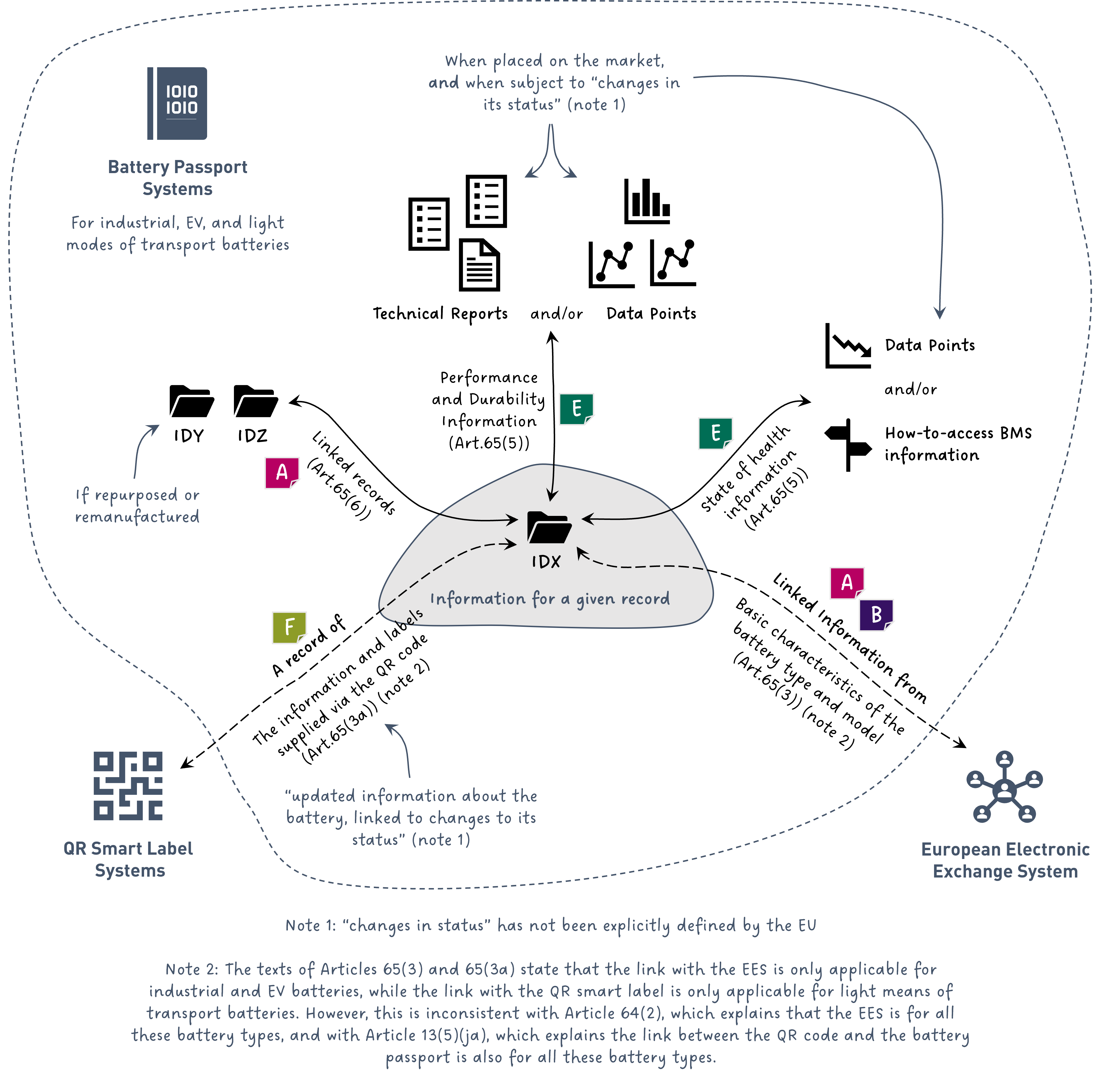
Art.65(5) → Art.10(1) Information about the values for performance and durability parameters as set out in Article 10(1), that cross-references Parts A and B of Annex IV.
Art.65(5) → Art.10(1)→ Annex IV(Part A) Parameters related to the electrochemical performance and durability:
(1) Rated capacity (in Ah) and capacity fade (in %).
(2) Power (in W) and power fade (in %).
(3) Internal resistance (in ꭥ), internal resistance increase (in %) and electrochemical impedance (inꭥ).
(4) Energy round trip efficiency and its fade (in %).
(5) Their expected life-time under the reference conditions for which they have been designed in terms of cycles and calendar years.
(5a) Self discharge.
Art.65(5) → Art.10(1)→ Annex IV(Part B) For explaining the measurements of parameters listed in Part A:
(1) Applied discharge rate and charge rate.
(2) Ratio between maximum allowed battery power and battery energy (Wh).
(3) Depth of discharge in the cycle-life test.
(4) Power capability at 80% and 20% state of charge.
(5) Any calculations performed with the measured parameters, if applicable.
It should be noted that Article 10(1) makes reference to technical documentation containing the above parameters. The current regulatory text is not explicit, and thus it is possible that the battery passport could contain a series of technical reports on performance, or the specific information points listed above, or both.
Art.65(5) → Art.14 Information about the state of health of the battery as set out in Article 14, that cross-references Annex VII.
Art.65(5) → Art.14 → Annex VII Parameters for determining the state of health of batteries:
Art.65(5) → Art.14 → Annex VII Parameters for determining the expected lifetime of batteries:
(1) The dates of manufacturing of the battery and putting into service;
(2) Energy throughput;
(3) Capacity throughput.
It should be noted that Article 14 requires that, for applicable batteries, a battery management system is included that captures real-time data to calculate and report the above information, with article 14(2) providing specific details for the access requirements to this information. Again, the regulations are not explicit, and thus it is possible that battery passport records may provide information on how to access information stored within battery management systems, and/or directly report the parameters identified above.
In the above instances, this information is required “when the battery is placed on the market and when it is subject to changes in its status”. In Article 65(6), the regulation talks of changes in status due to repurposing or remanufacturing activities, but has not provided a full and definitive list of status changes.
For industrial and electric vehicle batteries only (see note #)
Art.65(3) → Art.64 information about the basic characteristics of each battery type and model stored in the Electronic Exchange System (as set out in Article 64).
For light means of transport batteries only (see note #)
Cross-referenced information from the QR Labelling Requirements:
Art.65(3a) → Art.13(5)(a) → Art.13(5)(1) → Ann.VI(Part A) a [general] information label
Also Art.65(3a) → Art.13(5)(b)→Art.13(2)an [expected lifetime] label
Art.65(3a) → Art.13(5)(c) → Art.13(3)→ Annex VI(Part B) A label indicating separate collection
Art.65(3a) → Art.13(5)(d)→ Art.13(4) The chemical symbols for cadmium and lead (for all batteries with 0.002% Cd or 0.004% Pb)
Art.65(3a) → Art.13(5)(i) → Art.18 The declaration of conformity with the Battery Regulations
Art.65(3a) → Art.13(5)(j) → Art.60(1)Information on waste prevention
Art.65(3a) Any updated information about the battery, linked to changes in its status
For more information about the above points, please see our explainer on the QR Smart labeling requirements.
Note # – Articles 65(3) and 65(3a) are currently written to imply that only industrial and EV batteries require linkage with the Electronic Exchange System. However, the most recent amendments to Article 64(2) and Article 13(5)(ja) state that the EES will include light modes of transportation, and the QR information will be linked for all three battery types. It is possible that there is an error in Articles 65(3) and 65(3a), and that both sets of information are actually required for both types of battery.
Who is responsible for the Battery Passport?
The Battery Passport System is the responsibility of the battery manufacturer, in accordance with Article 65(1) and Article 65(2), being the organisation that first places the battery onto the market or puts the battery into service.
In accordance with Article 44, an importer or distributor is also considered a manufacturer if they:
(a) place a battery onto the market/into service under their own name.
(b) modify a manufacturers battery in a way that would affect compliance.
(c) change the purpose of the battery from that intended by the manufacturer.
In accordance with Article 65(6), in the event that a battery is repurposed or remanufactured, “the responsibility for the battery record in the battery passport shall be transferred to the economic operator that is considered to place the […] battery on the market or that puts it into service”.
In these instances, it is implied that a new battery record is created by the new economic operator, given that “the record for repurposed or remanufactured batteries shall be linked to the record of the original battery.
We hope that this information is useful to build awareness of the future information requirements of a Battery Passport system. However, we present this information without guarantee to its accuracy, given the transient nature of the EU regulatory development process, and the complexity of the regulations. Those seeking to understand the regulations in more detail are encouraged to read the original commission text and parliamentary amendments in more detail.
Regulatory Background
This European Regulation exists within a process of three stages and three sets of actors:
The European Commission (the EU’s politically independent executive arm) is responsible for drawing up proposals for new European legislation, and implementing these once agreed upon by the European Parliament and the Council of the EU. The European Commission (EC) first published its Proposal for a REGULATION OF THE EUROPEAN PARLIAMENT AND OF THE COUNCIL concerning batteries and waste batteries, repealing Directive 2006/66/EC and amending Regulation (EU) No 2019/1020 (source), on 10 December 2020.
The European Parliament (the EU’s elected governing body) is the EU’s lawmaking arm, responsible for passing EU laws, together with the Council of the EU. On 10 March 2022 (source), the European Parliament agreed to the council proposal, with amendments (source), principally to raise the level of ambition in the legislation.
The Council of the EU contains representatives of each member state in the EU, responsible for committing their respective governments to any agreed actions in EU meetings, including the adoption of new laws. On 9 December 2022 (source) it was announced that inter-institutional negotiations, between the commission, parliament, and the council of the EU had resulted in provisional agreement, that must now be formally approved by the commission and parliament.
The above information is based upon the amendments made by the European Parliament, as the content of the third-stage negotiations has not yet been published. Progress of this regulation can be tracked via the EU’s legislative train and procedure file pages.
NOTE – this blog post relates to a 2023 reserach project which was analysing the evolving EU Batteries Regulation.
The EU is soon to adopt new regulations for batteries and battery waste. These place new information requirements on a range of economic operators, who ‘place battery products “on the market” or “into service”. These terms are used by the EU to define who is responsible for supplying different information points (however in practice a third party may provide this information on the economic operator’s behalf). In this blog article, we introduce the EU’s definitions.
Please note, that while general shape of the regulation and it’s requirements is reasonably well known, until the regulation is officially published and comes into force, the regulatory text may change. See ‘regulatory background’ below for more detail.
The EU’s Basic Definitions
As per Article 1(1) and 1(1a), the EU’s new battery regulations establish new requirements for batteries, that must be satisfied before those products are ‘placed onto the market’ or ‘put into service’. Definitions of these terms are provided in Article 2. In accordance with the current regulatory text:
Article 2(14) ‘placing on the market’ is the act of “making available a battery for the first time on the Union Market”. ‘Making available’ is further characterized by Article 2(15), as “any supply of a battery for distribution or use on the market in the course of a commercial activity, whether in return for payment or free of charge”.
Article 2(16) ‘putting into service’ means the first use of a battery, for its intended purpose, within the Union.
Generally, these regulations are applicable for all new batteries, of any type (further detailed below), however there are exceptions for military, space and nuclear applications in Article 1(3).
As per Article 2(1), a ‘battery‘ is considered to be “any source of electrical energy generated by direct conversion of chemical energy and consisting of one or more non-rechargeable or rechargeable battery cells or of groups of them, such as battery packs and battery modules“. The EU generally separates batteries into five key application areas:
So, who is responsible for curating battery information?
The specific information requirements for battery passports, smart QR labels, and the EU’s Electronic Exchange System are detailed in separate blog posts. But generally speaking, it is the manufacturer that is responsible for the QR labeling requirements (Article 38(1)(b)), and it is the economic operators that place batteries on the market that are responsible for providing the necessary information to the EEES (Article 64(3)) and within the battery passport (Article 65(2)). As per article 40, when a manufacturer is not based in a member state, then the manufacturer must designate “a sole authorised representative” that will act on their behalf.
As per Article 2(19), an economic operator “means the manufacturer, the authorised representative, the importer, the distributor or the fulfilment service provider who is subject to obligations in relation to manufacturing batteries, making them available or placing them on the market or putting them into service in accordance with the present Regulation”. Importers or distributors are considered manufacturers and subject to the same requirements when (Article 44):
the battery is placed on the market/into service under the importer or distributors own name or trademark (Article 44(a))
a battery, already on the market, is modified by an importer or distributor in such a way that compliance is affected (Article 44(b))
the importer or distributor changes the purpose of the battery, that was intended by the manufacturer (Article 44(c).
Additional to the above, information obligations are also applied to organisations that repurpose or remanufacture batteries (Article 59), with the EU expecting that these organisations will take responsibility for the battery passport electronic record once they have introduced changes to the battery (Article 65(6)).
We hope that this information is useful to build awareness of the regulations. However, we present this information (January 2023) without guarantee to its accuracy, given the transient nature of the EU regulatory development process, and the complexity of the regulations. Those seeking to understand the regulations in more detail are encouraged to read the original commission text and parliamentary amendments in more detail.
Regulatory Background
This European Regulation exists within a process of three stages and three sets of actors:
The European Commission (the EU’s politically independent executive arm) is responsible for drawing up proposals for new European legislation, and implementing these once agreed upon by the European Parliament and the Council of the EU. The European Commission (EC) first published its Proposal for a REGULATION OF THE EUROPEAN PARLIAMENT AND OF THE COUNCIL concerning batteries and waste batteries, repealing Directive 2006/66/EC and amending Regulation (EU) No 2019/1020 (source), on 10 December 2020.
The European Parliament (the EU’s elected governing body) is the EU’s lawmaking arm, responsible for passing EU laws, together with the Council of the EU. On 10 March 2022 (source), the European Parliament agreed to the council proposal, with amendments (source), principally to raise the level of ambition in the legislation.
The Council of the EU contains representatives of each member state in the EU, responsible for committing their respective governments to any agreed actions in EU meetings, including the adoption of new laws. On 9 December 2022 (source) it was announced that inter-institutional negotiations, between the commission, parliament, and the council of the EU had resulted in provisional agreement, that must now be formally approved by the commission and parliament.
The above information is based upon the amendments made by the European Parliament, as the content of the third-stage negotiations has not yet been published. Progress of this regulation can be tracked via the EU’s legislative train and procedure file pages.
NOTE – this blog post relates to a 2023 reserach project which was analysing the evolving EU Batteries Regulation.
The EU is soon to adopt new regulations for batteries and battery waste. These place new information requirements on a range of economic operators, who place battery products “on the market” or “into service”, to make available a range of battery-related information points via a QR smart labels, battery passports, and via the EU’s proposed Electronic Exchange System (sometimes called the ‘European Dataspace for Batteries’). While these three ‘systems’ are presented separately in Articles 13, 64 and 65 of COM/2020/798, in practice their integration and overlapping functions mean that these cannot be understood in isolation from each other.
Different information is required dependent on the type of battery. As a general rule:
Battery Passports, and the data services (integrated with the EU’s Electronic Exchange System) are required for all industrial, electric vehicle, and light means of transport batteries.
Clicking on the above links will take you to pages explaining the detailed information requirements for each system.
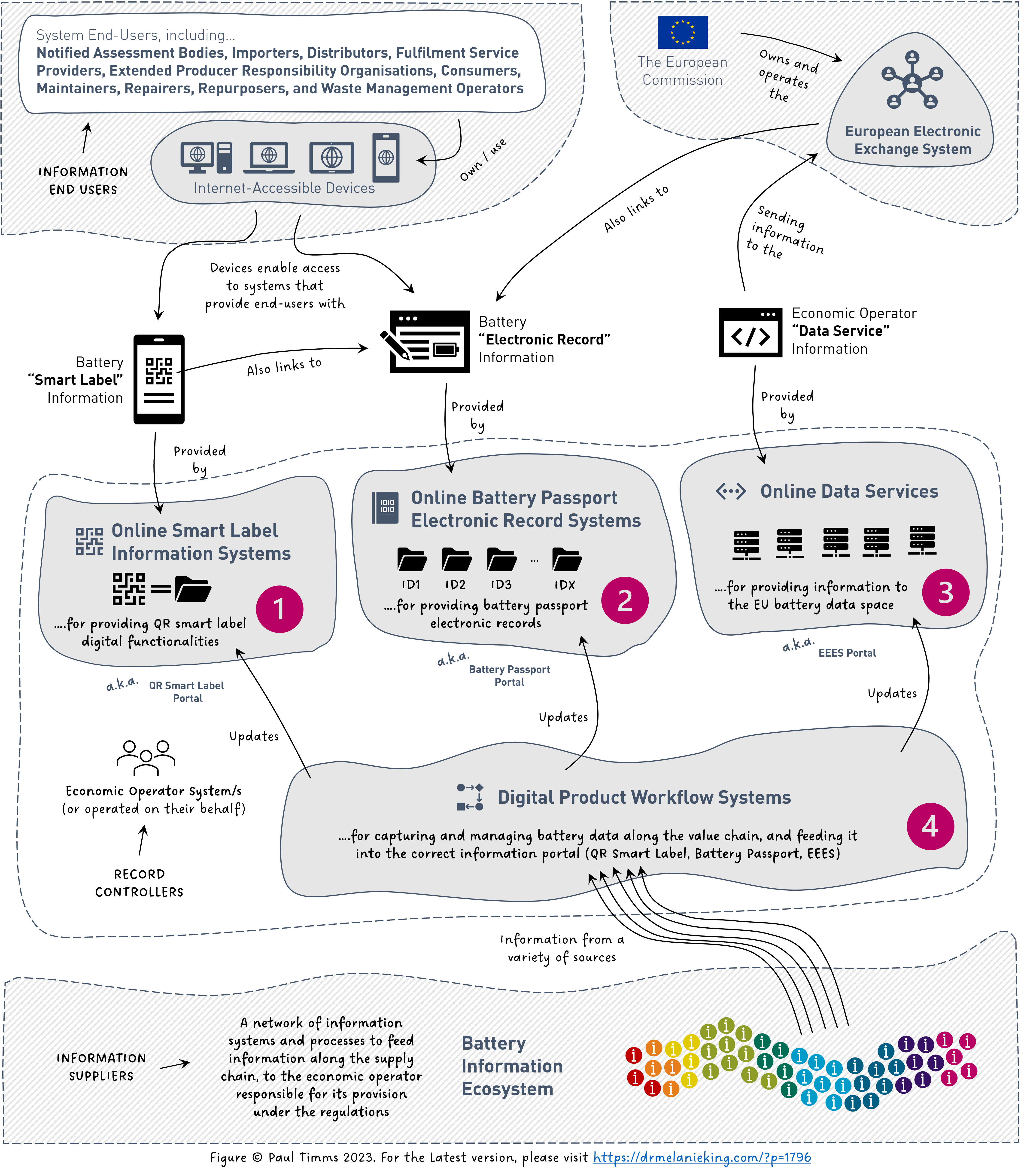
All economic operators, who place battery products “on the market” or “into service”, have a regulatory obligation to develop or commission information systems that deliver the necessary information to the necessary stakeholders. But all organisations in the manufacturing ecosystem will have a some responsibility for supplying information. We’ve attempted to show this in the figure below, that synthesizes the different components of a battery information ecosystem, as inferred by the regulations:
We hope that this information is useful to build awareness of the regulations. However, we present this information (January 2023) without guarantee to its accuracy, given the transient nature of the EU regulatory development process, and the complexity of the regulations. Those seeking to understand the regulations in more detail are encouraged to read the original commission text and parliamentary amendments in more detail.
Regulatory Background
This European Regulation exists within a process of three stages and three sets of actors:
The European Commission (the EU’s politically independent executive arm) is responsible for drawing up proposals for new European legislation, and implementing these once agreed upon by the European Parliament and the Council of the EU. The European Commission (EC) first published its Proposal for a REGULATION OF THE EUROPEAN PARLIAMENT AND OF THE COUNCIL concerning batteries and waste batteries, repealing Directive 2006/66/EC and amending Regulation (EU) No 2019/1020 (source), on 10 December 2020.
The European Parliament (the EU’s elected governing body) is the EU’s lawmaking arm, responsible for passing EU laws, together with the Council of the EU. On 10 March 2022 (source), the European Parliament agreed to the council proposal, with amendments (source), principally to raise the level of ambition in the legislation.
The Council of the EU contains representatives of each member state in the EU, responsible for committing their respective governments to any agreed actions in EU meetings, including the adoption of new laws. On 9 December 2022 (source) it was announced that inter-institutional negotiations, between the commission, parliament, and the council of the EU had resulted in provisional agreement, that must now be formally approved by the commission and parliament.
The above information is based upon the amendments made by the European Parliament, as the content of the third-stage negotiations has not yet been published. Progress of this regulation can be tracked via the EU’s legislative train and procedure file pages.
King, M, Timms, P & Mountney, S. (2022) A proposed universal definition of a Digital Product Passport Ecosystem (DPPE): Worldviews, discrete capabilities, stakeholder requirements and concerns, Journal of Cleaner Production, DOI: https://doi.org/10.1016/j.jclepro.2022.135538






 and battery energy (Wh).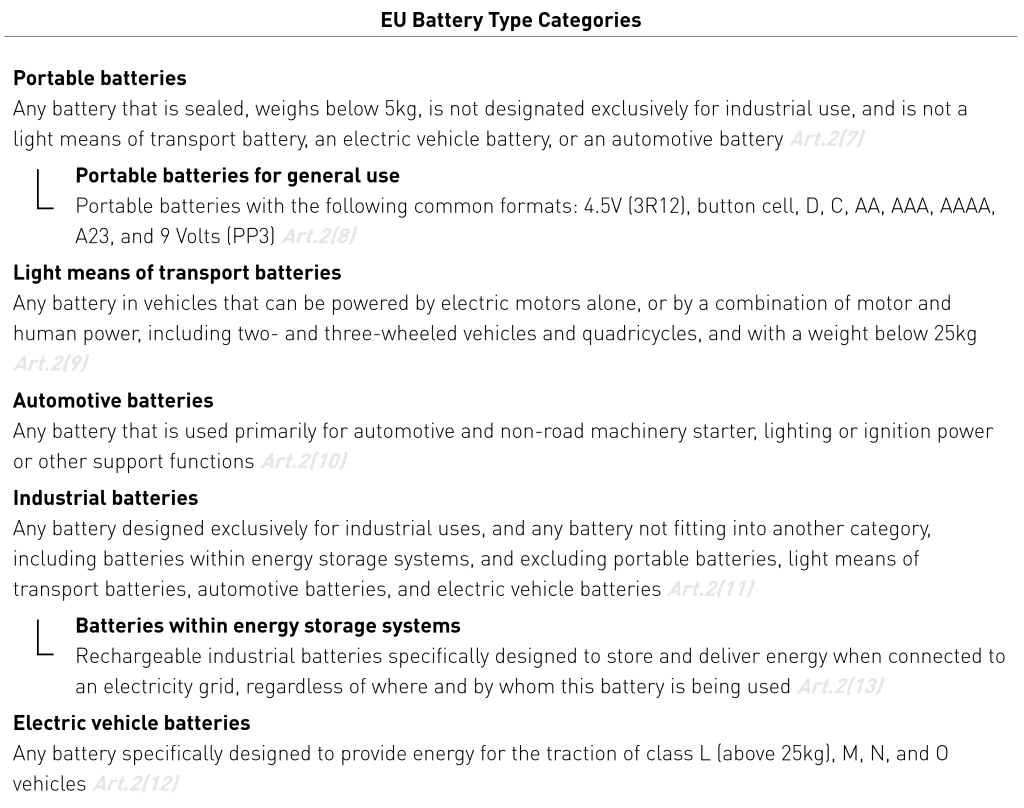
 Dr Melanie King, Loughborough University