

The information in this post is now superceded.
NOTE – this blog post relates to a 2023 reserach project which was analysing the evolving EU Batteries Regulation.
The EU is soon to adopt new regulations for batteries and battery waste. One significant part of these regulations is the introduction of a Smart QR Code, fitted to every battery product, that will give users access to a range of important information points information related to their battery’s capacity, performance, durability, chemical composition. Producers will need to adopt and develop QR Smart Label Systems, capable of supplying the information required by the EU.
This article explains the likely requirements, based on currently-available information. Please note, that while general shape of the regulation and it’s requirements is reasonably well known, until the regulation is officially published and comes into force, these information requirements may change. See ‘regulatory background’ below for more detail.
QR Smart Labels, and their role in the battery information ecosystem
QR Smart Labels are one of three new information systems, proposed under COM/2020/798, to improve the transfer of information between different stakeholders in the battery value chain. The other systems are a Battery Passport System, and an EU-operated Electronic Exchange System. While presented in separate articles of the regulation, these three information systems are inherently part of the same information ecosystem, with the regulations mandating interoperability and integration between the systems.

While these are generally presented as three separate systems in separate sections of the regulation, in practice they characterize different subsets of functionality of a larger battery information ecosystem, that transfers (and makes available) information across a manufacturer’s ecosystem. In effect, each system becomes a portal into a common information environment.
About Battery Labeling, and the requirements for QR Codes
The proposed regulation sets out new labeling requirements for battery products (cells, modules, and packs placed on the market) in Article 13. Specifically, Article 13(5) sets out new requirements for all finished battery products to include a QR code, that provides access to a range of information (below). These QR codes must be printed or engraved visibly, legibly and indelibly on the battery, and/or when batteries are incorporated in appliances, the QR code must be printed or engraved visibly, legible and indelibly on the appliances (Article 13(6)).
QR codes are “machine-readable matrix code[s] that link[] to information as required by this regulation” (Article 2(21)). They must be in accordance with Part C of Annex VI.
The QR code shall be in a colour with a high contrast compared to its background and of a size that is easily readable by a commonly available QR reader, such as those integrated in hand-held communication devices.
Part C of Annex VI
In accordance with Recital 28, QR codes should “respect the guidelines of ISO IEC Standard 18004“, and should also “be accessible for persons with disabilities in accordance with the requirements laid down in Directive (EU) 2019/882 of the European Parliament and of the Council”.
There is an exception within Article 13(6) that, “where it is not possible or not warranted on account of the nature and size of the battery, labels shall be affixed to the packaging and to the documents accompanying the battery”, however it must be noted that this exception does not explicitly call-out the QR code, whereas it does in other sentences of this requirement. Thus, in present form, it could be interpreted that the QR code must be on the battery in all circumstances.
It should be noted that, while the regulation focuses on the QR code technology, Article 13(6a) does give the commission the ability to adopt “alternative types of smart labels instead of or in addition to the QR-code, in view of technical and scientific progress”.
About QR Smart Label Systems
QR Smart Label systems are required, that can provide access via the QR code (fitted to battery products), to information specified in (and cross-referenced from) Article 13(5)(5) and Article 13(5)(6). This information is detailed below. In accordance with Article 13(5)(ja) and Article 65(4), from 1 January 2026 (for industrial, electric vehicle, and light means of transport batteries), the QR code must also link (provide online access) to the information contained within the battery passport.
In Article 13(6), it is currently stated that “the QR code shall also provide access to the publicly accessible part of the battery passport established pursuant to Article 65”. It is worth noting that Article 65 does not make reference to publicly accessible information. Battery passports are however meant to interoperate, and link to, the proposed Electronic Exchange System (EES) (as per Article 65(4)). The information requirements of the EES are set out in Annex XIII (as per Article 64(2)), where the notion of publicly accessible information is set out. It is reasonable to assume that this is the intent of this sentence within Article 13(6) – for the QR code to provide access to the EES system, rather than repeat the requirement for battery passport information, that is also set out in Article 13(5)(ja).
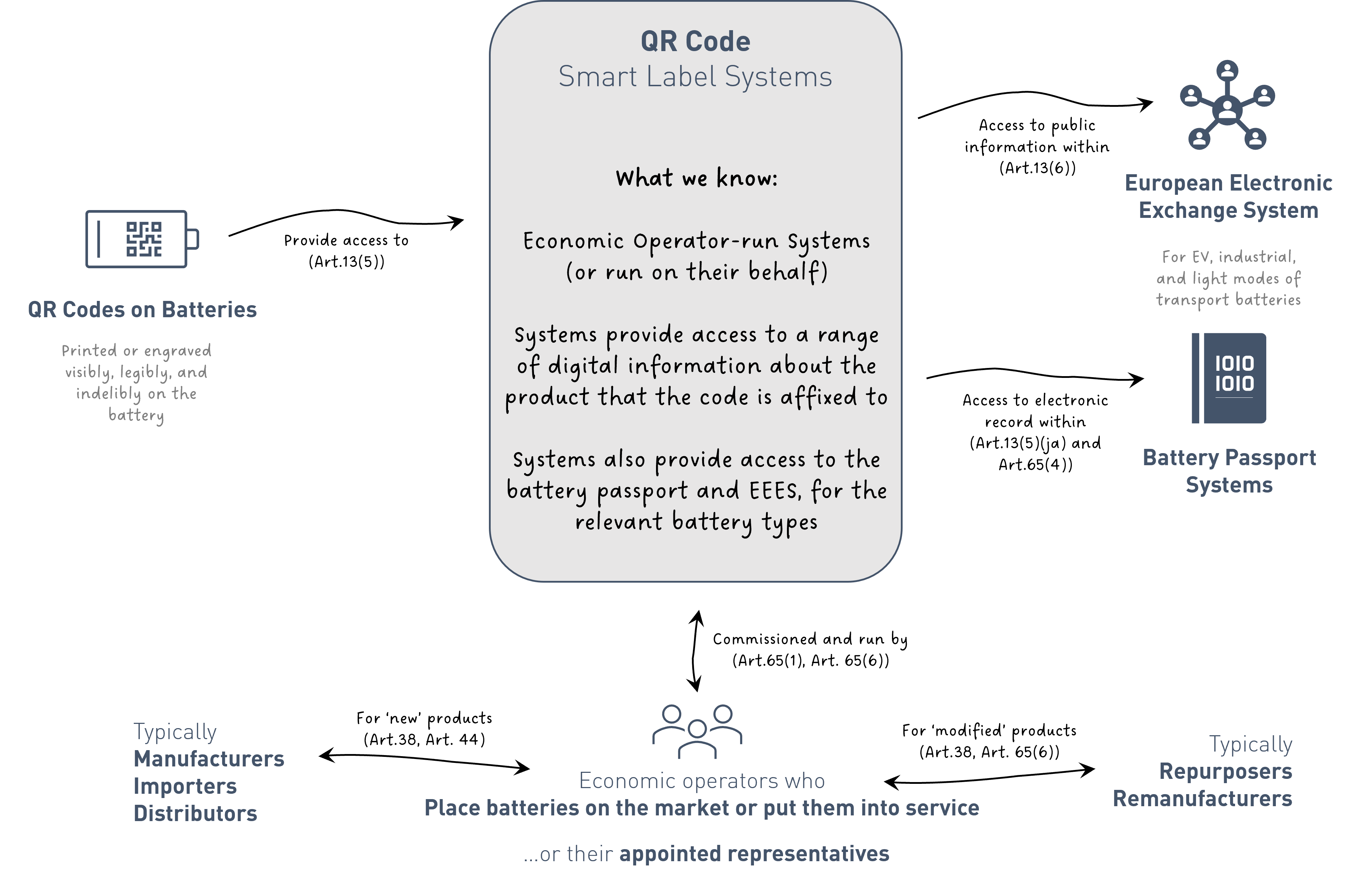
Notably, in accordance with Article 65(2), the battery passport “shall be unique for each individual battery”, and so the QR code may need to be individual-asset-specific, dependent on implementation.
What information goes into the QR smart label?
QR codes must provide access to the information set out in Article 13(5) and Article 13(6). Based on the deadlines currently set out in the parliamentary amendments to the regulation, the following information must be made available.
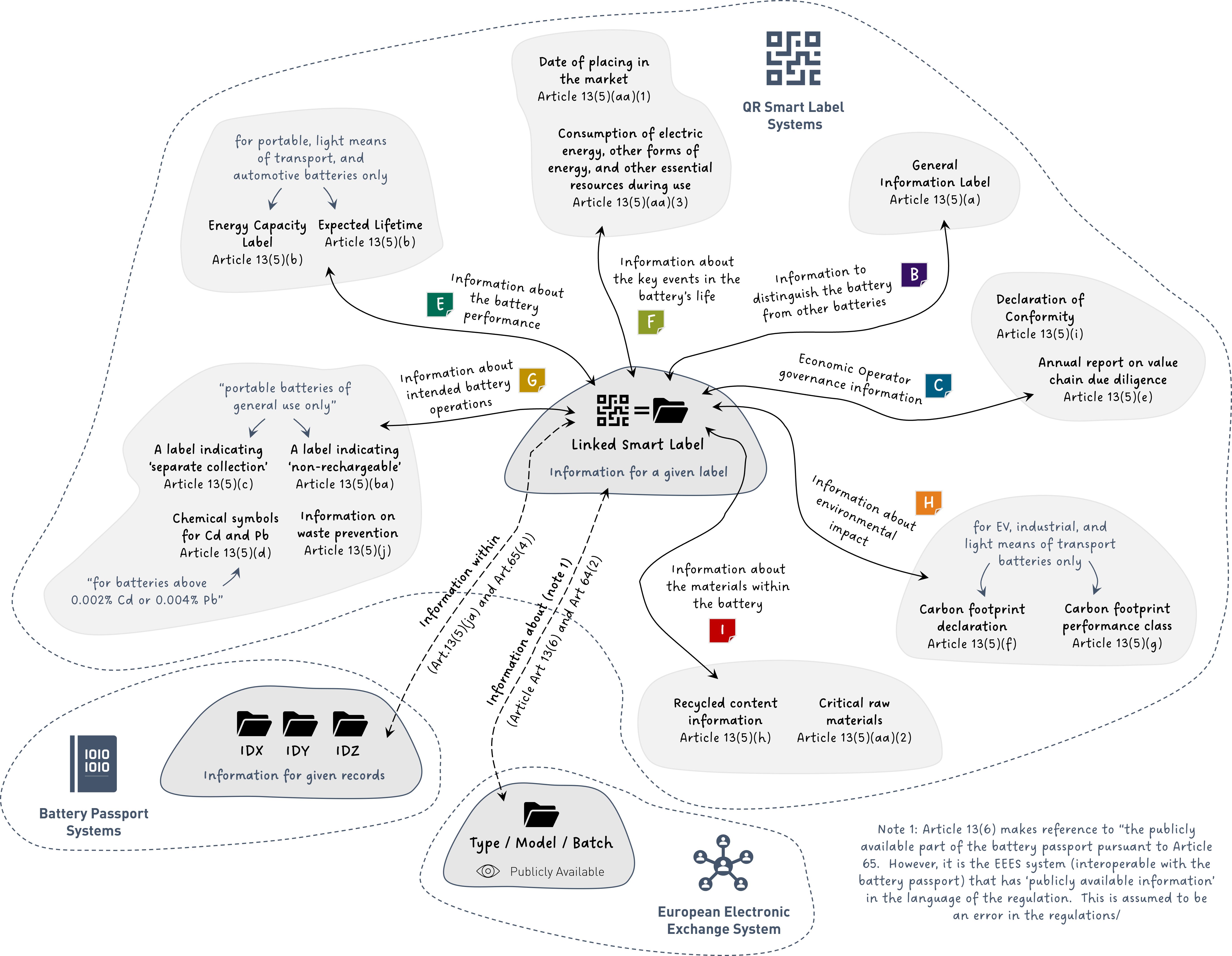
It must be noted that some of these deadlines have already passed, even though the regulation has yet to come into force, thus it is likely that some of these compliance dates may change.
1 January 2023
- Art.13(5)(ba) → Art.13(2a) A label indicating ‘non-rechargeable’ (for portable batteries of general use only)
- Art.13(5)(c) → Art.13(3) → Annex VI(Part B) A label indicating separate collection (for portable batteries of general use only)
- Art.13(5)(d)→ Art.13(4) The chemical symbols for cadmium and lead (for all batteries with 0.002% Cd or 0.004% Pb)
- Art.13(5)(i)→ Art.18 The declaration of conformity with the Battery Regulations (for all battery types)
1 July 2023
- Art.13(5)(j) → Art.60(1) Information on waste prevention, set out in points (a) to (f) of Article 60(1), regarding (for all battery types):
- (a) the contribution of end users to waste prevention, including by information on good practices and recommendations concerning the use of batteries aiming at extending their use phase and the possibilities of reuse, preparation for reuse, preparation for repurposing, repurposing and remanufacturing;
- (b) the role of end users in contributing to the separate collection of waste batteries in accordance with their obligations under Article 51 so as to allow their treatment and recycling;
- (c) the separate collection, take-back and collection points, preparation for re-use, preparation for repurposing, repurposing, remanufacturing and recycling systems available for waste batteries;
- (d) the necessary safety instructions to handle waste batteries, including in relation to the risks associated with, and the handling of, batteries containing lithium;
- (e) the meaning of the labels and symbols printed on batteries or on their packaging;
- (f) the impact of substances, in particular hazardous substances, contained in batteries on the environment and on human health, including impact due to inappropriate discarding of waste batteries such as littering or discarding as unsorted municipal waste.
Regulatory Adoption Date + 12 Months
- Art.13(5)(e) → Art.39(6) A report of value chain due diligence (for all battery types)
- Article 39(6) characterizes the full nature of this report, but in short, this is an annual report where the economic operator details the steps taken to comply with the value chain governance and due diligence requirements regarding, in particular, the raw materials contained in the battery product.
1 July 2024
- Art.13(5)(f) → Art.7(1) A carbon footprint declaration (for electric vehicle, industrial, and light means of transport batteries only)
1 January 2025
- Art.13(5)(aa) → Ann.VI(Part Aa) Information (for all battery types) relating to:
- (1) the date of placing on the market
- (2) all critical raw materials contained in the battery (above a concentration of 0.1% weight by weight)
- (3) the consumption of electric energy, other forms of energy and where relevant other essential resources during use.
1 July 2025
- Art.13(5)(g) → Art.7(2) Information about the carbon footprint performance class (for electric vehicle, industrial, and light means of transport batteries only)
- Art.13(5)(h) → Art.8 Information about the amount of cobalt, lead, lithium or nickel recovered from waste and present in active materials in the battery, in accordance with Article 8 (for portable batteries excluding those for general use, and for light means of transport, industrial, automotive and electric vehicle batteries only)
1 January 2026
- Art.13(5)(ja) and Art.13(6) the information contained within the battery passport electronic record as set out in Article 65 (for industrial, electric vehicle, and light means of transport batteries)
1 January 2027
- Art.13(5)(a)→Art.13(5)(1) →Ann.VI(Part A) a [general] information label containing the following information (for all battery types):
- (1) Manufacturer Name, Registered Trade Name or Trademark
- (2) Battery Type, Batch, Serial Number, or other elements, allowing unequivocal identification of the battery
- (3) Battery Model Identifier
- (4) Date of Manufacture
- (5a) Weight of the battery
- (6) Chemistry
- (7) Hazardous substances, other than mercury, cadmium, and lead, above a concentration of 0.1% weight by weight
- Art.13(5)(b)→Art.13(2) an [energy capacity] label providing information on the battery’s nominal energy capacity (for portable, light modes of transport, and automotive batteries only).
- Also Art.13(5)(b)→Art.13(2) an [expected lifetime] label providing information on (for portable, light modes of transport, and automotive batteries only):
- (1) Minimum average duration when used in specific circumstances
- (2[a]) Expected lifetime in terms of number of cycles
- (2[b]) Expected lifetime in terms of number of calendar years
The regulations do not define how this information should be presented within a given QR system, but the EU has defined, or is expected to define, harmonized standards for how many of the individual documents and labels are presented. In its most recent press release, the EU recognizes that “this new cradle-to-grave regulatory framework for batteries will require a lot of more detailed rules (secondary legislation) to be adopted from 2024 to 2028 to be fully operational”.
Who is responsible for the QR Code and QR Smart Label System?
The QR Smart Label System is the responsibility of the of the battery manufacturer, in accordance with Article 38(1)(b) and Article 38(7) for labeling requirements.
In accordance with Article 44, an importer or distributor is also considered a manufacturer if they:
- (a) place a battery onto the market/into service under their own name.
- (b) modify a manufacturers battery in a way that would affect compliance.
- (c) change the purpose of the battery from that intended by the manufacturer.
In accordance with Article 13(6), “in the event of remanufacturing or repurposing, labels shall be updated by a new label reflecting the new battery status”. In other sections of Article 13(6), ‘labels’ are described separately to QR codes. Unless there is an error in the text, this implies that the QR code (and consequential QR Smart Label System) remains the same even when other product labeling is changed.
the battery passport “shall be unique for each individual battery”, and so consequentially, the QR code may need to be individual-asset-specific.
We hope that this information is useful to build awareness of the future information requirements of a QR smart label system. However, we present this information without guarantee to its accuracy, given the transient nature of the EU regulatory development process, and the complexity of the regulations. Those seeking to understand the regulations in more detail are encouraged to read the original commission text and parliamentary amendments in more detail.
Regulatory Background
This European Regulation exists within a process of three stages and three sets of actors:
- The European Commission (the EU’s politically independent executive arm) is responsible for drawing up proposals for new European legislation, and implementing these once agreed upon by the European Parliament and the Council of the EU. The European Commission (EC) first published its Proposal for a REGULATION OF THE EUROPEAN PARLIAMENT AND OF THE COUNCIL concerning batteries and waste batteries, repealing Directive 2006/66/EC and amending Regulation (EU) No 2019/1020 (source), on 10 December 2020.
- The European Parliament (the EU’s elected governing body) is the EU’s lawmaking arm, responsible for passing EU laws, together with the Council of the EU. On 10 March 2022 (source), the European Parliament agreed to the council proposal, with amendments (source), principally to raise the level of ambition in the legislation.
- The Council of the EU contains representatives of each member state in the EU, responsible for committing their respective governments to any agreed actions in EU meetings, including the adoption of new laws. On 9 December 2022 (source) it was announced that inter-institutional negotiations, between the commission, parliament, and the council of the EU had resulted in provisional agreement, that must now be formally approved by the commission and parliament.
The above information is based upon the amendments made by the European Parliament, as the content of the third-stage negotiations has not yet been published. Progress of this regulation can be tracked via the EU’s legislative train and procedure file pages.
 Dr Melanie King, Loughborough University