King, M, Timms, P & Mountney, S. (2022) A proposed universal definition of a Digital Product Passport Ecosystem (DPPE): Worldviews, discrete capabilities, stakeholder requirements and concerns, Journal of Cleaner Production, DOI: https://doi.org/10.1016/j.jclepro.2022.135538
Read article …
Tag: Ecosystems
Insights (3): The EU timeline for information in the Battery Passport
Insights post – Part 3 of 3.
The information in this post is now superceded.
NOTE – this blog post relates to a 2023 reserach project which was analysing the evolving EU Batteries Regulation.
In Part 2 of our Insights post, we introduced the specific information points that the EU expects to be accessible within the Battery Passport.
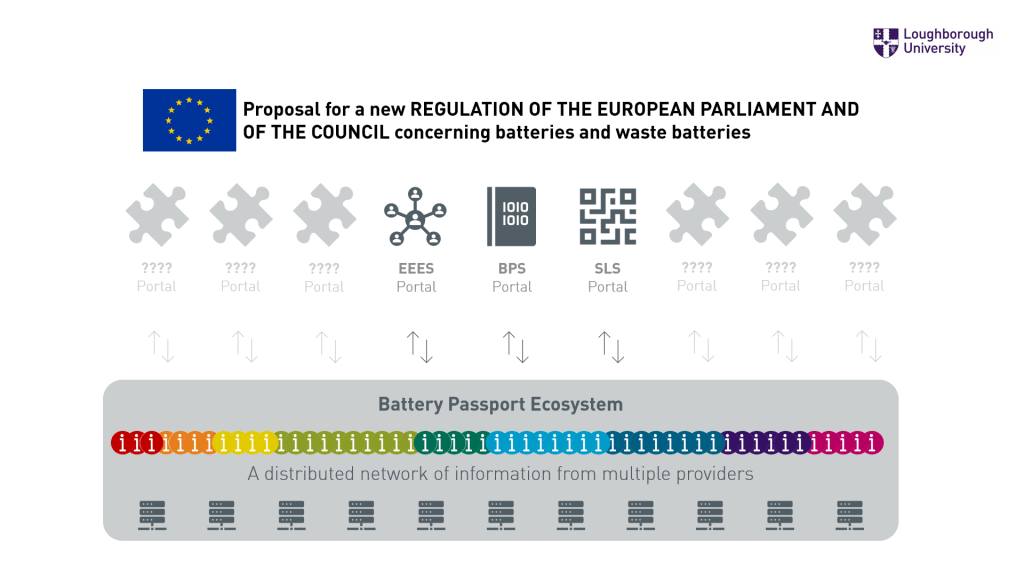
In this video, we explain the timeline, by which these information points should be accessible via the Smart Label, Battery Passport, and Electronic Exchange System Portals.
In short: The QR label requirements come first, and are applicable to all types of battery. For industrial and EV batteries, further performance information must be provided via the passport. The Electronic Exchange then requires duplicate access to much of this information. This video ends in an observation; that while the EU explicitly defines three information exchange systems, there are many other forms of information exchange required by the regulation that could also form part of the Battery Passport Ecosystem.

This will be the subject of our next insights article.
Insights (2): Explicit Information Requirements for the EU’s Battery Passport
Insights Post – Part 2 of 3.
The information in this post is now superceded.
NOTE – this blog post relates to a 2023 reserach project which was analysing the evolving EU Batteries Regulation.
In Part 1of our series of insights post, we provided a basic overview of the EU’s new Battery Regulations and what this meant for the idea of a product passport ecosystem, finishing on a set of nine questions that characterise the information sought by the EU.
In this second video, we cover the explicit information requirements of the EU’s battery regulation mapped on to the nine key functions of a battery passport ecosystem, as identified from our research.
Part 3 of our insights posts goes on to describe the timeline by which these information points should be accessible.
Why Digital Product Passports for EV and E-Mobility Batteries?
Focusing on data innovation opportunities for Battery Passports for second-life applications

Batteries are manufactured from (predominantly) finite material resources. To ensure the continued availability of critical raw materials, circular lifecycle strategies must be adopted, that manage the flow and availability of the battery product and its constituent parts and materials. High-quality data is required, that can support production, use, re-use, second life, and end-of-life decision-making across the battery value chain.
Proposed by both the UK and the EU, battery passports/product passports are positioned as the mechanism for effective information exchange; a unique electronic record for each manufactured battery that contains all the information necessary to maximise extracted value from materials, and ensure the ongoing availability of those materials for future use. Both the UK and the EU have started to define the types of product information that should be captured by product passports, but the current approach tends to focus on the outputs of a single enterprise – considering battery production and use as a wholly-linear activity. However, battery value chains are complex, networked arrangements of organisations and activities, with multiple re-use, second-life, and end-of-life circularity loops. Each of these loops can also be understood at multiple levels (e.g. re-use, second-life and end-of-life of the battery, re-use, second-life and end-of-life of battery components, and the re-use, second-life, and end-of-life of materials within the battery).
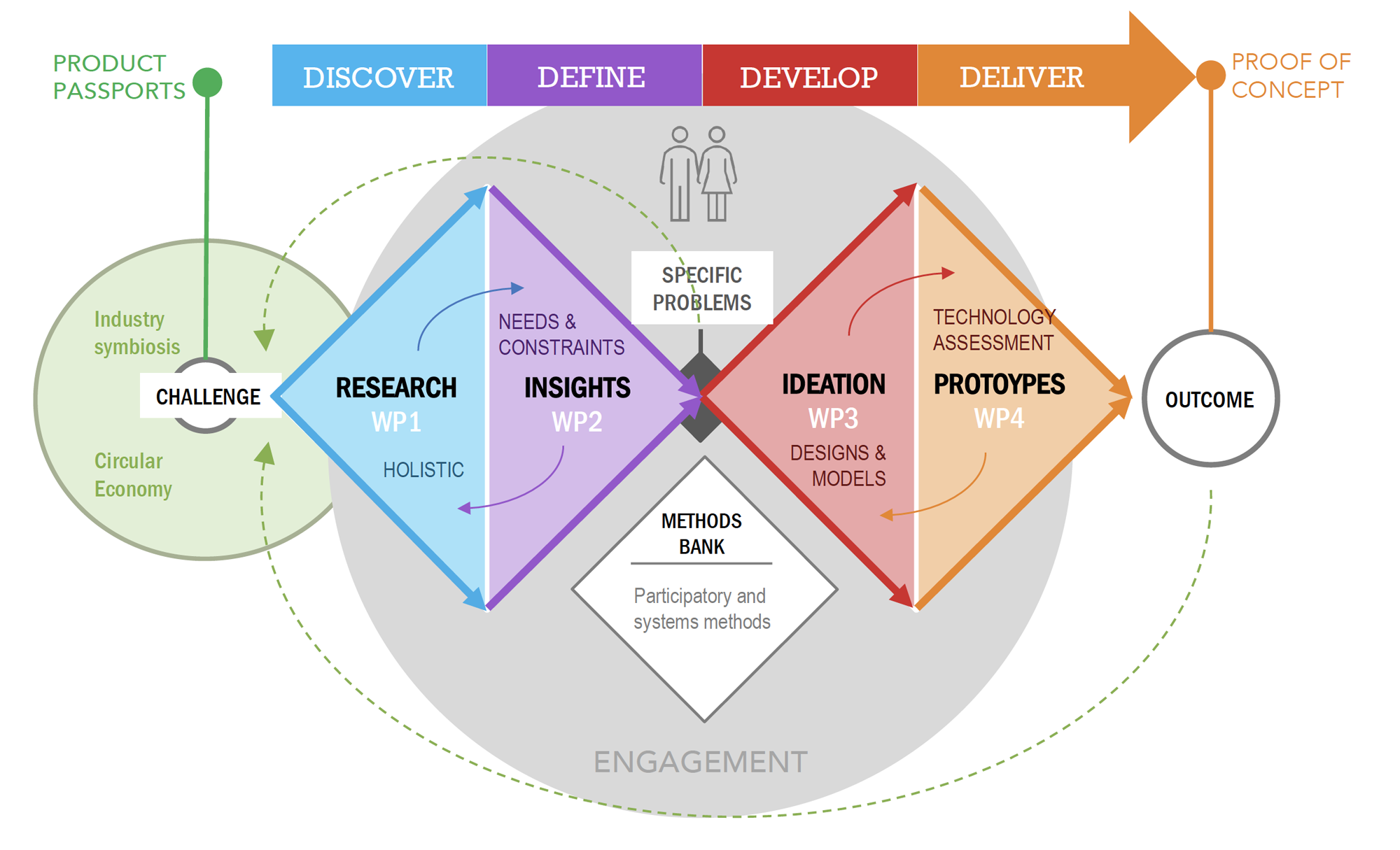
Adopting a system of systems approach, our research seeks to develop a proof of concept and technical demonstrator for an interoperable digital passport information system for the UK, one that addresses this inherent complexity and supports re-use, second life, and end-of-life applications across the value chain. Different loops enable different types of sustainable business models, enabled by different types of information.
We’d like to consult with stakeholders from across the battery lifecycle to understand the viability of these different circularity models, and the information you need (or already have) to make these loops a reality. Putting the multi-stakeholder concept at the forefront of the concept design and development, we hope to identify the challenges and solutions of multiple, interlinked DPPs, that hitherto have not been addressed or considered fully within product passport proposals.
Please email me, Dr Melanie King, to have your say.

Book Chapter: ‘Big Data in Insurance’ in the Palgrave Handbook of Technological Finance
King, M.R.N., Timms, P.D. & Rubin, T. H., (2021). ‘Big Data in Insurance’, in Raghavendra, R., Wardrop, R. & Zingales, L. (ed.) The Palgrave Handbook of Technological Finance. Palgrave Macmillan, pp.669-700.
Publisher version …
Product Passports Project – Aims and Objectives
One of the key challenges identified in the first round of UKMSN+ studies are related to the development of information sharing platforms that enable and support industrial symbiosis. However, in Feb’21 the UK Government put the National Materials Database (NMDHub) project on hold but it re-iterated support for their Product Passport vision, in order to identify the quantity and type of critical raw materials within a given product, and introduce labelling and information requirements as part of the Environment Bill, for example; repairability rating, common faults and remedies, spare parts, instructions for common repairs and upgrades etc.
The aim of this 16 month feasibility project is to generate and test new concepts for product passports in order to contribute significantly to the national effort by developing and evaluating a technical demonstrator of a concept for a product passport system and a data publishing specification. The government recognises the need to take a ‘whole-systems’ approach and it is this context this project proposal has been conceived.
Our research project aims to answer the following questions:
- How viable is the notion of a product passport for resource identification and exchange, from a whole systems perspective, and what technologies, data model and distributed architecture might underpin its use to enable cross-industry utility?
- Which concepts of operation for product passports, are most feasible in the context of enabling new business models, ecosystems and circular economy capability?
- What circular economy (holistic) insights could product passports enable with extended capability e.g. data innovations and data-enabled infrastructures like Data trusts, distributed ledger, AI, and connected/smart technologies?
Project Approach

The project will utilise participatory research and collaborative design and development approaches as much as possible, including Systems Thinking and Hackathon style workshops. Our project is different because it aims to break down silos, apply data-driven innovation principles and focus on System of System capability by looking at:
What sort of data and information should an open product passport contain that will enable cross-industry applicability and opportunities for new value streams? What is core and priority critical materials across sectors and within products? What data should be public domain v commercially sensitive? What information architectures would facilitate re-use and integrations? What technologies could be used for data capture etc? How would a product passport work in the context of product-service systems and more complex systems comprised of multiple sub-systems and modular components? What policy frameworks, regulations and governance might be needed? How feasible are our proposals and what are the practical considerations?
If you would like to get involved, please get in touch with me via email: m.r.n.king@lboro.ac.uk
Applying Systems of Systems Engineering (SoSE) in healthcare: the case for a soft systems methodology approach to digital-first primary care
Shahzad, I, King, M, Henshaw, M (2021) Applying SoSE in healthcare: the case for a soft systems methodology approach to digital-first primary care. In 16th Annual System of Systems Engineering Conference, Västerås, Sweden (Online).
Read full paper …
Using foresight futures and systems thinking to evaluate digitally enhanced advanced service concepts for a rolling stock company (ROSCO)
King, M, Mountney, S, Timms, P (2021) Using foresight futures and systems thinking to evaluate digitally enhanced advanced service concepts for a rolling stock company (ROSCO). In The Spring Servitization Conference (SSC2021); Proceedings of the Spring Servitization Conference (SSC2021), Virtual.
Read full paper …
Advocating systems approaches outside of engineering: reporting on research with the UK insurance sector towards the adoption of trustworthy AI-enabled systems
Timms, P and King, M (2020) Advocating systems approaches outside of engineering: reporting on research with the UK insurance sector towards the adoption of trustworthy AI-enabled systems. In The UK Annual Systems Engineering Conference (ASEC) 2020, Enstone, Oxfordshire, UK (Virtual Conference).
Read full paper …
Digitally Supporting the Co-creation of Future Advanced Services for ‘Heat as a Service’
Mountney, S, Ross, T, May, A, Qin, S-F, Nui, X, King, M, Kapoor, K, Story, V, Burton, J (2020) Digitally supporting the co-creation of future advanced services for ‘Heat as a Service’. In Bigdeli, A and Baines, T (ed) The Spring Servitization Conference 2020; Proceedings of the The Spring Servitization Conference 2020, Birmingham, UK [Virtual conference], pp.64-71, ISBN: 9781854494290.
Read paper …