

This work is part of ongoing research in relation to product and battery passports. Find out more about the projects here: Researching Product Passport systems for the Circular Economy.
Browse the following articles to find out more about the EU’s plans for Battery Passports

We hope that the following information is useful to build awareness of the imminent and future regulations. However, we present this information (January 2023) without guarantee to its accuracy, given the transient nature of the EU regulatory development process, and the complexity of the regulations. Those seeking to understand the regulations in more detail are encouraged to read the original commission text and parliamentary amendments in more detail.
EU Battery Regs (1): The battery information obligations on economic operators
The EU is soon to adopt new regulations for batteries and battery waste. These place new information requirements on a range of economic operators, who place battery products “on the market” or “into service”, to make available a range of battery-related information points via a QR smart labels, battery passports, and via the EU’s proposed…
Keep reading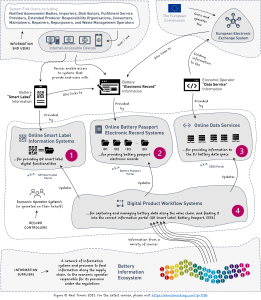
EU Battery Regs (2): Placing “on the market” and “putting into service”
The new regs place information requirements on a range of economic operators. This page outlines definitions of the terms ‘placing on the market’ and ‘putting into service’, the EU Battery Category Types and roles and responsibilities.
Keep reading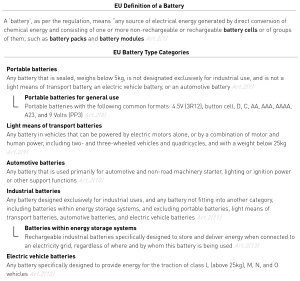
EU Battery Regs (3): Battery passports
For an electric vehicle, industrial, and light modes of transport batteries, producers will need to adopt and develop battery passport systems, that provide an electronic record for each individual battery that is placed on the market.
Keep reading
EU Battery Regs (4): QR Smart Labels
This article explains the likely requirements for QR Smart Labels and their role in the battery information ecosystem, based on currently-available information.
Keep reading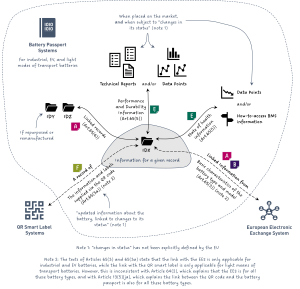
EU Battery Regs (5): The European Electronic Exchange System
This article explains the likely requirements for the European Electronic Exchange System (EEES), based on currently-available information.
Keep reading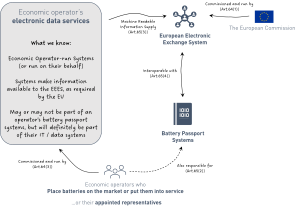
Regulatory Background
This European Regulation exists within a process of three stages and three sets of actors:
- The European Commission (the EU’s politically independent executive arm) is responsible for drawing up proposals for new European legislation, and implementing these once agreed upon by the European Parliament and the Council of the EU. The European Commission (EC) first published its Proposal for a REGULATION OF THE EUROPEAN PARLIAMENT AND OF THE COUNCIL concerning batteries and waste batteries, repealing Directive 2006/66/EC and amending Regulation (EU) No 2019/1020 (source), on 10 December 2020.
- The European Parliament (the EU’s elected governing body) is the EU’s lawmaking arm, responsible for passing EU laws, together with the Council of the EU. On 10 March 2022 (source), the European Parliament agreed to the council proposal, with amendments (source), principally to raise the level of ambition in the legislation.
- The Council of the EU contains representatives of each member state in the EU, responsible for committing their respective governments to any agreed actions in EU meetings, including the adoption of new laws. On 9 December 2022 (source) it was announced that inter-institutional negotiations, between the commission, parliament, and the council of the EU had resulted in provisional agreement, that must now be formally approved by the commission and parliament.
The above information is based upon the amendments made by the European Parliament, as the content of the third-stage negotiations has not yet been published. Progress of this regulation can be tracked via the EU’s legislative train and procedure file pages.
 Dr Melanie King, Loughborough University