Launched: DrMelanieKing.com

It’s about time!

After months in the planning (and with a summer of respite from teaching and Covid related matters) I have finally launched my new website.

Why do this?

  • Because I have so much more to share than is possible from my standard staff profile page. Particularly with the growing number of projects I have been involved with in recent years.
  • I am particularly excited about my latest project too – “Data Innovations for Product Passports” – please have a read and share widely with your networks. My colleague, Dr Sara Mountney, and I are keen to engage with as wider network as possible and Circular Economy initiatives have never been so important!
  • I also do ‘systems’ research, which means I am hard to categorise! I hope to convey my research aims more succinctly in this website and show how systems engineering and System of Systems approaches to digitalization and development is crucial – no matter what Industry you work in.
  • Finally, I thought it would be a great way to share interesting insights that I am finding along the way, much quicker than pulling together the story at the end of the research and formally publishing in the traditional way. I have lots of publications to share but what this space for a growing blog on the latest developments from different industries.

Product Passports Project – Aims and Objectives

One of the key challenges identified in the first round of UKMSN+ studies are related to the development of information sharing platforms that enable and support industrial symbiosis. However, in Feb’21 the UK Government put the National Materials Database (NMDHub) project on hold but it re-iterated support for their Product Passport vision, in order to identify the quantity and type of critical raw materials within a given product, and introduce labelling and information requirements as part of the Environment Bill, for example; repairability rating, common faults and remedies, spare parts, instructions for common repairs and upgrades etc.

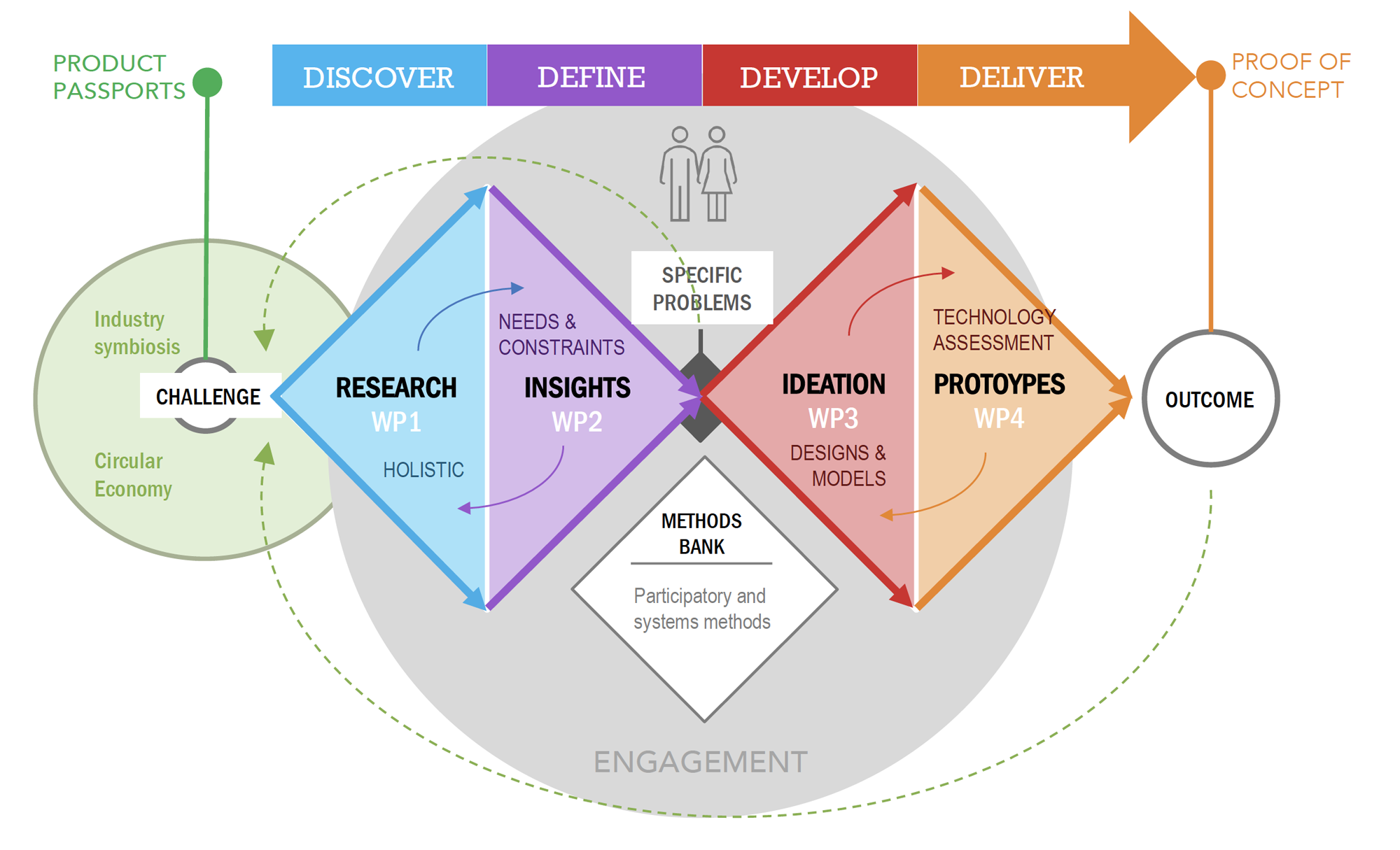
The aim of this 16 month feasibility project is to generate and test new concepts for product passports in order to contribute significantly to the national effort by developing and evaluating a technical demonstrator of a concept for a product passport system and a data publishing specification. The government recognises the need to take a ‘whole-systems’ approach and it is this context this project proposal has been conceived.

Our research project aims to answer the following questions:

  1. How viable is the notion of a product passport for resource identification and exchange, from a whole systems perspective, and what technologies, data model and distributed architecture might underpin its use to enable cross-industry utility?
  2. Which concepts of operation for product passports, are most feasible in the context of enabling new business models, ecosystems and circular economy capability?
  3. What circular economy (holistic) insights could product passports enable with extended capability e.g. data innovations and data-enabled infrastructures like Data trusts, distributed ledger, AI, and connected/smart technologies?

Project Approach

The project will utilise participatory research and collaborative design and development approaches as much as possible, including Systems Thinking and Hackathon style workshops. Our project is different because it aims to break down silos, apply data-driven innovation principles and focus on System of System capability by looking at:

What sort of data and information should an open product passport contain that will enable cross-industry applicability and opportunities for new value streams? What is core and priority critical materials across sectors and within products? What data should be public domain v commercially sensitive? What information architectures would facilitate re-use and integrations? What technologies could be used for data capture etc? How would a product passport work in the context of product-service systems and more complex systems comprised of multiple sub-systems and modular components? What policy frameworks, regulations and governance might be needed? How feasible are our proposals and what are the practical considerations?

If you would like to get involved, please get in touch with me via email: m.r.n.king@lboro.ac.uk

Applying Systems of Systems Engineering (SoSE) in healthcare: the case for a soft systems methodology approach to digital-first primary care

Shahzad, I, King, M, Henshaw, M (2021) Applying SoSE in healthcare: the case for a soft systems methodology approach to digital-first primary care. In 16th Annual System of Systems Engineering Conference, Västerås, Sweden (Online).

Read full paper …

Using foresight futures and systems thinking to evaluate digitally enhanced advanced service concepts for a rolling stock company (ROSCO)

King, M, Mountney, S, Timms, P (2021) Using foresight futures and systems thinking to evaluate digitally enhanced advanced service concepts for a rolling stock company (ROSCO). In The Spring Servitization Conference (SSC2021); Proceedings of the Spring Servitization Conference (SSC2021), Virtual.

Read full paper …

Advocating systems approaches outside of engineering: reporting on research with the UK insurance sector towards the adoption of trustworthy AI-enabled systems

Timms, P and King, M (2020) Advocating systems approaches outside of engineering: reporting on research with the UK insurance sector towards the adoption of trustworthy AI-enabled systems. In The UK Annual Systems Engineering Conference (ASEC) 2020, Enstone, Oxfordshire, UK (Virtual Conference).

Read full paper …

Digitally Supporting the Co-creation of Future Advanced Services for ‘Heat as a Service’

Mountney, S, Ross, T, May, A, Qin, S-F, Nui, X, King, M, Kapoor, K, Story, V, Burton, J (2020) Digitally supporting the co-creation of future advanced services for ‘Heat as a Service’. In Bigdeli, A and Baines, T (ed) The Spring Servitization Conference 2020; Proceedings of the The Spring Servitization Conference 2020, Birmingham, UK [Virtual conference], pp.64-71, ISBN: 9781854494290.

Read paper …

Response to the European Commission’s Consultation on Artificial Intelligence: A European approach to excellence and trust

King, M and Timms, P (2020) Response to the European Commission’s Consultation on Artificial Intelligence: A European approach to excellence and trust. TechNGI Project Report.

Read response …

UK smart cities present and future: An analysis of British smart cities through current and emerging technologies and practices

Brown, W, King, M, Goh, YM (2020) UK smart cities present and future: An analysis of British smart cities through current and emerging technologies and practices, Emerald Open Research, 2, pp.4-4, DOI: 10.35241/EMERALDOPENRES.13415.2.

Read article …