

The information in this post is now superceded.
NOTE – this blog post relates to a 2023 reserach project which was analysing the evolving EU Batteries Regulation.
The EU is soon to adopt new regulations for batteries and battery waste. For electric vehicle, industrial, and light modes of transport batteries, producers will need to adopt and develop battery passport systems, that provide an electronic record for each individual battery that is placed on the market.
This article explains the likely requirements, based on currently-available information. Please note, that while general shape of the regulation and it’s requirements is reasonably well known, until the regulation is officially published and comes into force, these information requirements may change. See ‘regulatory background’ below for more detail.
Battery passports, and their role in the battery information ecosystem
Battery passports are one of three new types of information system, proposed under COM/2020/798, to improve the transfer of information between different stakeholders in the battery value chain. In addition to battery passports, the regulation also introduces new QR smart labels, and an EU-coordinated electronic information exchange system, with the regulations mandating interoperability and integration between them.

While these are generally presented as three separate systems in separate sections of the regulation, in practice they characterize different subsets of functionality of a larger battery information ecosystem, that transfers (and makes available) information across a manufacturer’s ecosystem. In effect, each system becomes a portal into a common information environment.
About Battery Passports
According to the EU (Recital 94 of the regulation), the role of a battery passport is to allow different economic operators to to gather and reuse information and data on individual batteries in a ‘more efficient’ way, allowing them to make ‘better informed choices in their planning activities’. Its focus is on the sharing of information that is considered unique to each individual battery asset, and the creation (and maintenance) of individual electronic records for individual batteries (Articles 65(1) and 65(2)).
As per Article 65(2), each battery passport [electronic record] “shall be identified through a unique identifier that the economic operator placing the battery on the market shall attribute to it and which shall be printed or engraved on it”. This economic operator (typically a manufacturer, importer, or distributor) is responsible for ensuring that “the data included in the electronic record is accurate, complete, and up to date” (Article 65(3)) for the life of the battery asset, unless a different economic operator repurposes or remanufactures the associated battery (Article 65(6)).

As per Article 65(4), economic operators will be responsible for commissioning “electronic systems” that are interoperable with the European Electronic Exchange System defined in Article 64. These systems must be accessible online, directly via the internet, and also via the QR smart label printed or engraved on the battery. Article 65(6) implies that the records of repurposed or remanufactured batteries will be separate, but linked.
The commission has not defined how these systems will operate, but “in order to ensure uniform conditions for the implementation of the battery passport” (recital 94), Article 65(7) empowers the commission to establish rules, via delegated acts, for accessing, sharing, managing, exploring, publishing and reusing this information and data.
What information goes in a battery passport electronic record?
Battery passport systems must store and/or provide access to the battery electronic record information specified in (and cross-referenced from) Article 65(1), Article 65(3), Article 65(3a), Article 65(5), and Article 65(6). In all cases, this information must be available by 1 January 2026.
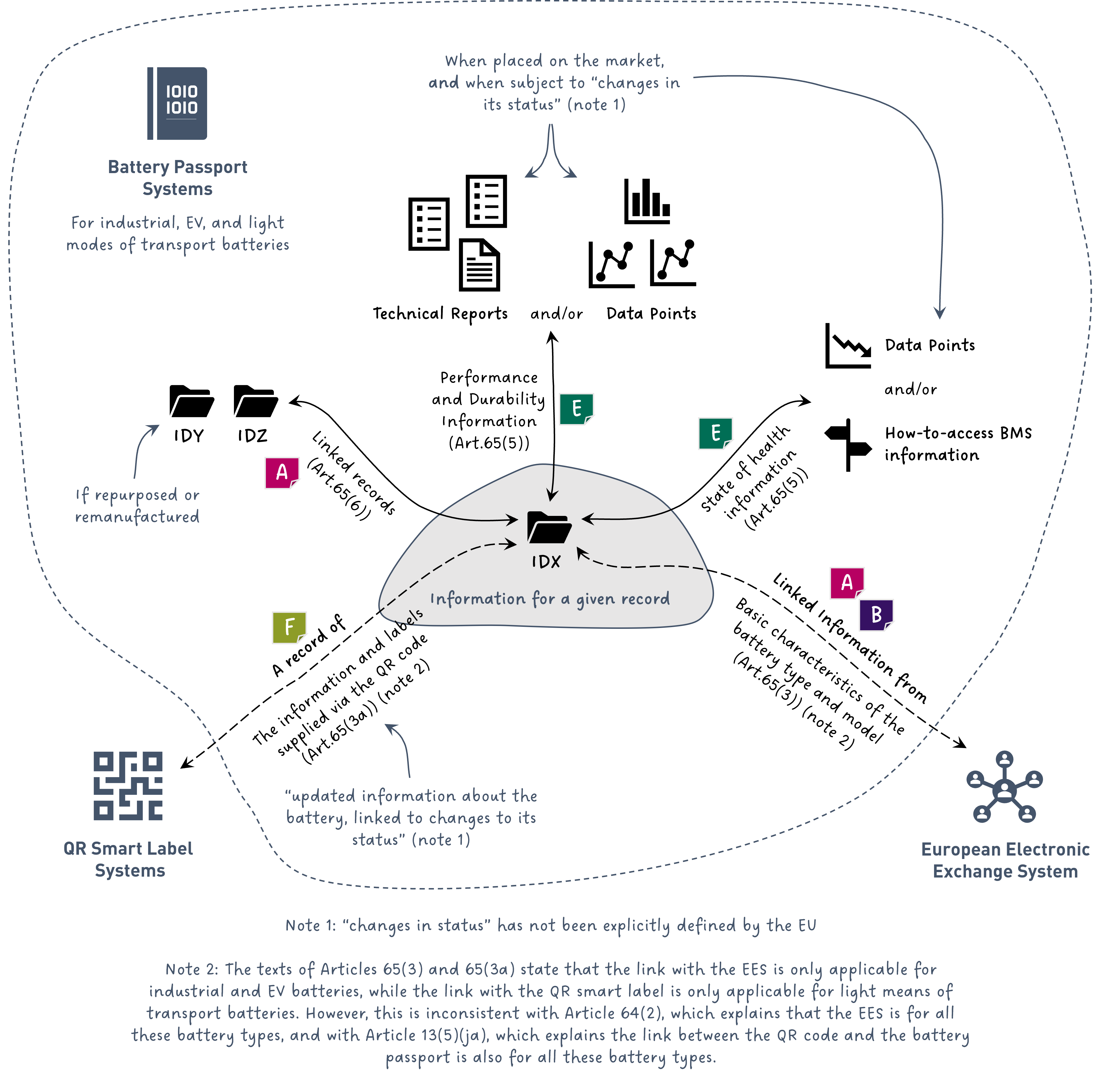
For all battery types
- Art. 65(1) The unique identifier for each individual battery passport [electronic record].
- Art. 65(6) The unique identifier for any linked/associated individual battery passport [electronic records].
- Art.65(5) → Art.10(1) Information about the values for performance and durability parameters as set out in Article 10(1), that cross-references Parts A and B of Annex IV.
- Art.65(5) → Art.10(1) → Annex IV(Part A) Parameters related to the electrochemical performance and durability:
- (1) Rated capacity (in Ah) and capacity fade (in %).
- (2) Power (in W) and power fade (in %).
- (3) Internal resistance (in ꭥ), internal resistance increase (in %) and electrochemical impedance (inꭥ).
- (4) Energy round trip efficiency and its fade (in %).
- (5) Their expected life-time under the reference conditions for which they have been designed in terms of cycles and calendar years.
- (5a) Self discharge.
- Art.65(5) → Art.10(1) → Annex IV(Part B) For explaining the measurements of parameters listed in Part A:
- (1) Applied discharge rate and charge rate.
- (2) Ratio between maximum allowed battery power
 and battery energy (Wh).
 - (3) Depth of discharge in the cycle-life test.
- (4) Power capability at 80% and 20% state of charge.
- (5) Any calculations performed with the measured parameters, if applicable.
- It should be noted that Article 10(1) makes reference to technical documentation containing the above parameters. The current regulatory text is not explicit, and thus it is possible that the battery passport could contain a series of technical reports on performance, or the specific information points listed above, or both.
- Art.65(5) → Art.10(1) → Annex IV(Part A) Parameters related to the electrochemical performance and durability:
- Art.65(5) → Art.14 Information about the state of health of the battery as set out in Article 14, that cross-references Annex VII.
- Art.65(5) → Art.14 → Annex VII Parameters for determining the state of health of batteries:
- (1) Remaining capacity;
- (2) Overall capacity fade;
- (3) Remaining power capability and power fade;
- (4) Remaining round trip efficiency;
- (5) Actual cooling demand;
- (6) Evolution of self-discharging rates;
- (7) Ohmic resistance and/or electrochemical impedance.
- Art.65(5) → Art.14 → Annex VII Parameters for determining the expected lifetime of batteries:
- (1) The dates of manufacturing of the battery and putting into service;
- (2) Energy throughput;
- (3) Capacity throughput.
- It should be noted that Article 14 requires that, for applicable batteries, a battery management system is included that captures real-time data to calculate and report the above information, with article 14(2) providing specific details for the access requirements to this information. Again, the regulations are not explicit, and thus it is possible that battery passport records may provide information on how to access information stored within battery management systems, and/or directly report the parameters identified above.
- Art.65(5) → Art.14 → Annex VII Parameters for determining the state of health of batteries:
In the above instances, this information is required “when the battery is placed on the market and when it is subject to changes in its status”. In Article 65(6), the regulation talks of changes in status due to repurposing or remanufacturing activities, but has not provided a full and definitive list of status changes.
For industrial and electric vehicle batteries only (see note #)
- Art.65(3) → Art.64 information about the basic characteristics of each battery type and model stored in the Electronic Exchange System (as set out in Article 64).
For light means of transport batteries only (see note #)
- Cross-referenced information from the QR Labelling Requirements:
- Art.65(3a) → Art.13(5)(a) → Art.13(5)(1) → Ann.VI(Part A) a [general] information label
- Art.65(3a) → Art.13(5)(b) → Art.13(2) an [energy capacity] label
- Also Art.65(3a) → Art.13(5)(b)→Art.13(2) an [expected lifetime] label
- Art.65(3a) → Art.13(5)(c) → Art.13(3) → Annex VI(Part B) A label indicating separate collection
- Art.65(3a) → Art.13(5)(d)→ Art.13(4) The chemical symbols for cadmium and lead (for all batteries with 0.002% Cd or 0.004% Pb)
- Art.65(3a) → Art.13(5)(i) → Art.18 The declaration of conformity with the Battery Regulations
- Art.65(3a) → Art.13(5)(j) → Art.60(1) Information on waste prevention
- Art.65(3a) Any updated information about the battery, linked to changes in its status
- For more information about the above points, please see our explainer on the QR Smart labeling requirements.
Note # – Articles 65(3) and 65(3a) are currently written to imply that only industrial and EV batteries require linkage with the Electronic Exchange System. However, the most recent amendments to Article 64(2) and Article 13(5)(ja) state that the EES will include light modes of transportation, and the QR information will be linked for all three battery types. It is possible that there is an error in Articles 65(3) and 65(3a), and that both sets of information are actually required for both types of battery.
Who is responsible for the Battery Passport?
The Battery Passport System is the responsibility of the battery manufacturer, in accordance with Article 65(1) and Article 65(2), being the organisation that first places the battery onto the market or puts the battery into service.
In accordance with Article 44, an importer or distributor is also considered a manufacturer if they:
- (a) place a battery onto the market/into service under their own name.
- (b) modify a manufacturers battery in a way that would affect compliance.
- (c) change the purpose of the battery from that intended by the manufacturer.
In accordance with Article 65(6), in the event that a battery is repurposed or remanufactured, “the responsibility for the battery record in the battery passport shall be transferred to the economic operator that is considered to place the […] battery on the market or that puts it into service”.
In these instances, it is implied that a new battery record is created by the new economic operator, given that “the record for repurposed or remanufactured batteries shall be linked to the record of the original battery.
We hope that this information is useful to build awareness of the future information requirements of a Battery Passport system. However, we present this information without guarantee to its accuracy, given the transient nature of the EU regulatory development process, and the complexity of the regulations. Those seeking to understand the regulations in more detail are encouraged to read the original commission text and parliamentary amendments in more detail.
Regulatory Background
This European Regulation exists within a process of three stages and three sets of actors:
- The European Commission (the EU’s politically independent executive arm) is responsible for drawing up proposals for new European legislation, and implementing these once agreed upon by the European Parliament and the Council of the EU. The European Commission (EC) first published its Proposal for a REGULATION OF THE EUROPEAN PARLIAMENT AND OF THE COUNCIL concerning batteries and waste batteries, repealing Directive 2006/66/EC and amending Regulation (EU) No 2019/1020 (source), on 10 December 2020.
- The European Parliament (the EU’s elected governing body) is the EU’s lawmaking arm, responsible for passing EU laws, together with the Council of the EU. On 10 March 2022 (source), the European Parliament agreed to the council proposal, with amendments (source), principally to raise the level of ambition in the legislation.
- The Council of the EU contains representatives of each member state in the EU, responsible for committing their respective governments to any agreed actions in EU meetings, including the adoption of new laws. On 9 December 2022 (source) it was announced that inter-institutional negotiations, between the commission, parliament, and the council of the EU had resulted in provisional agreement, that must now be formally approved by the commission and parliament.
The above information is based upon the amendments made by the European Parliament, as the content of the third-stage negotiations has not yet been published. Progress of this regulation can be tracked via the EU’s legislative train and procedure file pages.
 Dr Melanie King, Loughborough University